When One Customer Becomes Too Important - How to Manage the Customer Concentration Risk
Updated: Aug 27
Many businesses quietly live with the same reality:
one customer pays a very large part of the bills.
It might be 20%, 30%, sometimes more of total revenue.
That relationship often feels like both a blessing and a vulnerability at the same time - because it is.
The question isn’t whether concentration is good or bad.
The question is how deliberately you manage it.
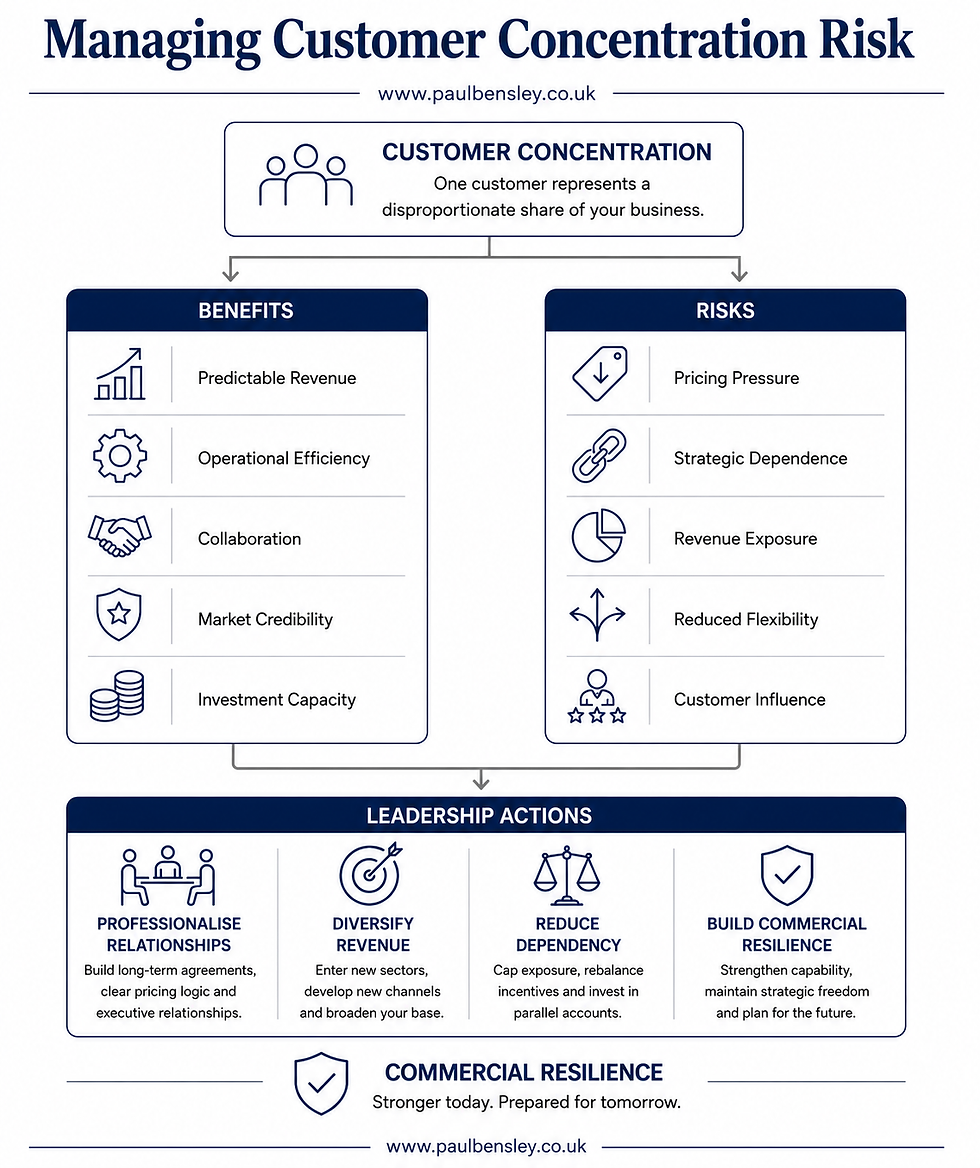
The pros we shouldn’t pretend don’t exist
Large customers bring real advantages:
predictable volume
efficient operations
lower acquisition cost
deeper product collaboration
credibility in the market
Some of the best businesses I’ve seen were built on the back of one demanding customer who forced them to become better.
Customer Concentration Risk can create capability.
The uncomfortable cons
But the risks are just as real:
pricing power shifts away from you
strategy becomes shaped by one buyer
investment decisions lose independence
staff start to feel like an extension of the customer
one contract change can reset the entire P&L
The biggest danger is psychological: the business stops thinking like a company and starts thinking like a supplier department.
Three strategic choices
When you recognise over-reliance, there are only three honest options.
1. Accept it and professionalise it Treat the customer like a joint venture: – long-term agreements – clear pricing logic – shared roadmaps – executive relationships beyond procurement
2. Diversify deliberately Use the cash and credibility to: – enter adjacent sectors – develop new channels – build products that travel beyond one buyer
3. Reduce dependency by design Not by walking away, but by: – capping exposure – rebalancing incentives – investing in parallel accounts
Doing nothing is also a choice - just the most dangerous one.
Board & leadership checklist
Commercial exposure
What % of revenue and margin comes from the top customer?
What % of growth next year depends on them?
How much pricing power do we truly have?
Relationship resilience
Do we have multiple senior relationships or one gatekeeper?
Is the relationship wider than procurement?
Could a change of buyer change everything?
Operational dependency
Have we built bespoke processes only for them?
Would those assets transfer to other customers?
Do service exceptions hide true cost?
Financial reality
What is the real cost-to-serve including rework and concessions?
How profitable would the business be without them?
Do we price complexity properly?
Strategic freedom
Are investment decisions being made for one customer or the market?
Do we still own our product roadmap?
Is innovation portable to other sectors?
Contingency
What is the plan if volume falls 20–30%?
How quickly could we replace lost revenue?
Who owns that plan?
Practical ways to manage the relationship
Protect margin through structure Volume should not automatically equal discount. Link price to service levels, complexity and commitment.
Create multiple relationships If all contact sits with one buyer, you don’t have a customer — you have a hostage situation.
Own your product roadmap Collaborate, but don’t outsource strategy to one client.
Know your true cost-to-serve Big customers often look profitable until every exception is counted.
Plan for the day after Ask regularly: If this contract reduced by 30%, what would we do?
The hidden opportunity: Customer Concentration Risk
Paradoxically, a dominant customer can be a platform for growth.
They can help you:
refine your proposition
prove your capability
fund investment
build reputation
The key is to treat that success as a launch pad, not a comfort blanket.
Final thought
Over-reliance on one customer isn’t a moral failure. It’s a strategic condition.
Managed well, it can build a formidable business. Managed poorly, it becomes a single point of failure disguised as loyalty.
The difference lies in leadership, discipline and the courage to plan beyond the next purchase order.
I’ll keep sharing practical perspectives on commercial risk and growth in my other articles on my website and here on LinkedIn.
If you found this article useful, you may also enjoy:
FAQs
What is customer concentration risk?
Customer concentration risk occurs when a significant proportion of a company's revenue, profit or future growth depends on a small number of customers. The greater the dependency, the greater the potential financial impact if one of those customers reduces spending, changes supplier or renegotiates terms.
When does one customer become too important?
There is no universal percentage at which concentration automatically becomes unacceptable. A customer representing 20% of revenue may present very different risk depending on contract length, profitability, switching risk, relationship strength, market position and how easily the revenue could be replaced.
Is 20% of revenue from one customer too much?
It can represent significant concentration, but percentage of revenue alone is not enough to assess the risk. Leaders should also consider gross profit contribution, contract security, customer behaviour, operational dependency and how long replacement revenue would take to generate.
Is 30% of revenue from one customer dangerous?
A customer representing 30% of revenue creates material exposure for many businesses because a significant reduction could affect profitability, cash flow and operational capacity. However, the appropriate response is to understand and actively manage the dependency rather than automatically trying to reduce the relationship.
How do you calculate customer concentration risk?
Start by calculating each major customer's percentage of total revenue and gross profit. Then assess additional factors such as expected future growth, contract duration, pricing power, cost-to-serve, switching probability and operational dependency.
Why is customer concentration risky?
High concentration can increase vulnerability to contract loss, volume reductions, pricing pressure, procurement changes and changes in customer strategy. It can also gradually influence the supplier's own investment decisions, product development and operating model.
Is customer concentration always bad?
No. Large customers can provide predictable volume, operational efficiency, lower acquisition costs, market credibility and opportunities for product development. Concentration becomes dangerous when the organisation does not understand or manage the dependency it creates.
What are the benefits of having one large customer?
A major customer can provide scale, stable demand and opportunities to develop capabilities that might otherwise take years to build. A demanding customer can also help a supplier improve its products, processes, service capability and reputation.
What are the warning signs of excessive customer dependency?
Warning signs include increasing price concessions, bespoke processes, dependence on one customer for future growth, investment decisions driven primarily by that customer and reluctance to challenge unreasonable requests. Another warning sign is when losing the customer becomes almost impossible for leadership to contemplate.
How can customer concentration affect pricing power?
The more financially dependent a supplier becomes on one customer, the more difficult it may become to resist requests for discounts, additional services or commercial concessions. The customer may gain negotiating leverage because both parties understand the consequences of losing the relationship are unequal.
How can businesses reduce reliance on one customer?
Dependency can be reduced by growing other accounts, entering adjacent markets, developing additional channels and creating products that appeal beyond the dominant customer. The objective does not necessarily need to be reducing revenue from the largest customer. It can be growing everything around it faster.
Should you deliberately reduce sales to your biggest customer?
Usually not simply because the customer is large. If the relationship is profitable and strategically valuable, deliberately giving up good revenue may destroy value. A better approach can be to retain the customer while reducing its percentage of the overall business through growth elsewhere.
What is the best way to diversify customer concentration?
Use the cash, capability and credibility created by the major customer to develop other sources of revenue. This could include adjacent sectors, new geographic markets, additional channels or other customers with similar requirements.
How should a business manage a strategically important customer?
Treat the relationship with appropriate structure. This can include longer-term agreements, transparent pricing mechanisms, joint planning, multiple executive relationships and clearer expectations around service and investment.
Why are multiple relationships important within a key account?
If the entire relationship depends on one buyer or contact, a personnel change can dramatically alter the account. Strong key-account management creates relationships across procurement, operations, technical teams and senior leadership, reducing dependence on one individual.
How does customer concentration affect strategic independence?
A dominant customer can gradually influence the supplier's product roadmap, investment priorities, service model and resource allocation. Collaboration can be valuable, but leaders need to ensure decisions still support the wider market rather than effectively turning the business into an extension of one customer.
What is operational dependency on a customer?
Operational dependency occurs when significant parts of the organisation have been designed specifically around one customer's requirements. This might include dedicated equipment, processes, inventory, people or service arrangements that have limited value elsewhere.
Why is cost-to-serve important with large customers?
Large customers can appear highly profitable because of their revenue and volume while generating significant hidden costs through special deliveries, bespoke requirements, rework, rebates, extended payment terms and service exceptions. Understanding true profitability requires these costs to be included.
Does higher customer volume always justify a lower price?
No. Higher volume can create efficiencies, but it can also introduce complexity and service requirements. Pricing should reflect the economics of the relationship, including volume, commitment, cost-to-serve and operational demands, rather than assuming that larger customers automatically deserve lower prices.
What should a business do if its biggest customer threatens to leave?
First understand the financial and operational exposure, then identify whether the underlying issue can be resolved without accepting commercially damaging terms. Leaders should simultaneously activate contingency plans rather than allowing fear of losing the customer to determine every negotiation.
How should businesses plan for losing their largest customer?
Model scenarios such as a 20%, 30%, 50% or complete reduction in volume. Understand the impact on revenue, gross profit, cash, capacity and fixed costs, then determine which customers, markets or cost actions could realistically compensate.
What is customer concentration stress testing?
Customer concentration stress testing models what would happen if a major customer reduced or removed its business. Rather than simply measuring the customer's percentage of revenue, leaders examine the consequences for profitability, cash flow, capacity and the wider operating model.
How can a large customer become a platform for growth?
A major customer can help a business prove its capability, refine its proposition, fund investment and build market credibility. Those capabilities can then be transferred to other customers and markets, turning concentration into a platform for diversification.
How do you stop a large customer controlling your product roadmap?
Separate customer collaboration from strategic ownership. Listen carefully to important customers, but assess whether requested developments are portable to other customers or markets before committing significant resources. One customer's requirement should not automatically become the company's strategy.
Should customer concentration be discussed at board level?
Yes, when the exposure could materially affect company performance. Boards should understand revenue and margin concentration, relationship resilience, operational dependency, contractual protection and contingency plans, rather than viewing concentration purely as a sales issue.
What metrics should businesses use to monitor customer concentration?
Useful measures include percentage of revenue, percentage of gross profit, percentage of forecast growth, true cost-to-serve, contract duration, revenue at risk and time required to replace lost business. Looking only at revenue concentration can hide the real economic exposure.
What are the strategic options when customer concentration becomes too high?
There are three broad choices:
1. Accept and professionalise the relationship2. Diversify deliberately around it3. Reduce dependency by design
The important thing is making the choice consciously rather than allowing concentration to increase without a strategy.
What is the biggest mistake businesses make with customer concentration?
The biggest mistake is often doing nothing because the relationship is currently successful. Concentration can feel comfortable while volumes are growing and relationships are strong. The vulnerability only becomes obvious when circumstances change.
How can leaders turn customer concentration risk into competitive advantage?
Use the relationship as a launch pad rather than a comfort blanket. Extract transferable capabilities, reputation, insight and investment from serving the major customer, then deliberately apply those advantages to acquiring and developing other customers.


Comments