How B2B Trade Businesses Survive in a World of Cheaper Online Competitors
Updated: Aug 27
The B2B trade businesses world has changed.
Pricing is transparent. Margins are visible. Customers compare instantly. Online players operate with lower overheads and lower margin expectations.
And it does not stop there.
The lines between retail and trade are blurring.
Retailers are moving into trade supply. Trade distributors are selling direct to end users. Manufacturers are experimenting with direct channels.
Customer expectations have shifted permanently.
The question is not how to fight this shift.
It is how to win within it.
The blurring of retail and trade
Historically, trade supply and retail operated in different lanes.
That separation is disappearing.
Retailers now compete in categories traditionally dominated by trade suppliers, such as:
Kitchens
Bathrooms
Window coverings
Flooring
Lighting
A homeowner can now source online or via retail channels at highly competitive prices.
Contractors increasingly see those prices too.
This creates pricing pressure in categories that were once commercially protected.
At the same time, some B2B suppliers move closer to end users, intensifying channel tension.
The result is permanent price transparency and structural competition.
Trying to ignore it is not a strategy.
The uncomfortable truth
If your only differentiator is price, you will lose.
Online and retail players are structurally built for:
Lower fixed cost
Lean staffing
Automated transactions
Centralised inventory
Lower margin expectations
Trying to match their pricing model by cutting overhead alone leads to a race to the bottom.
Traditional trade businesses win differently.
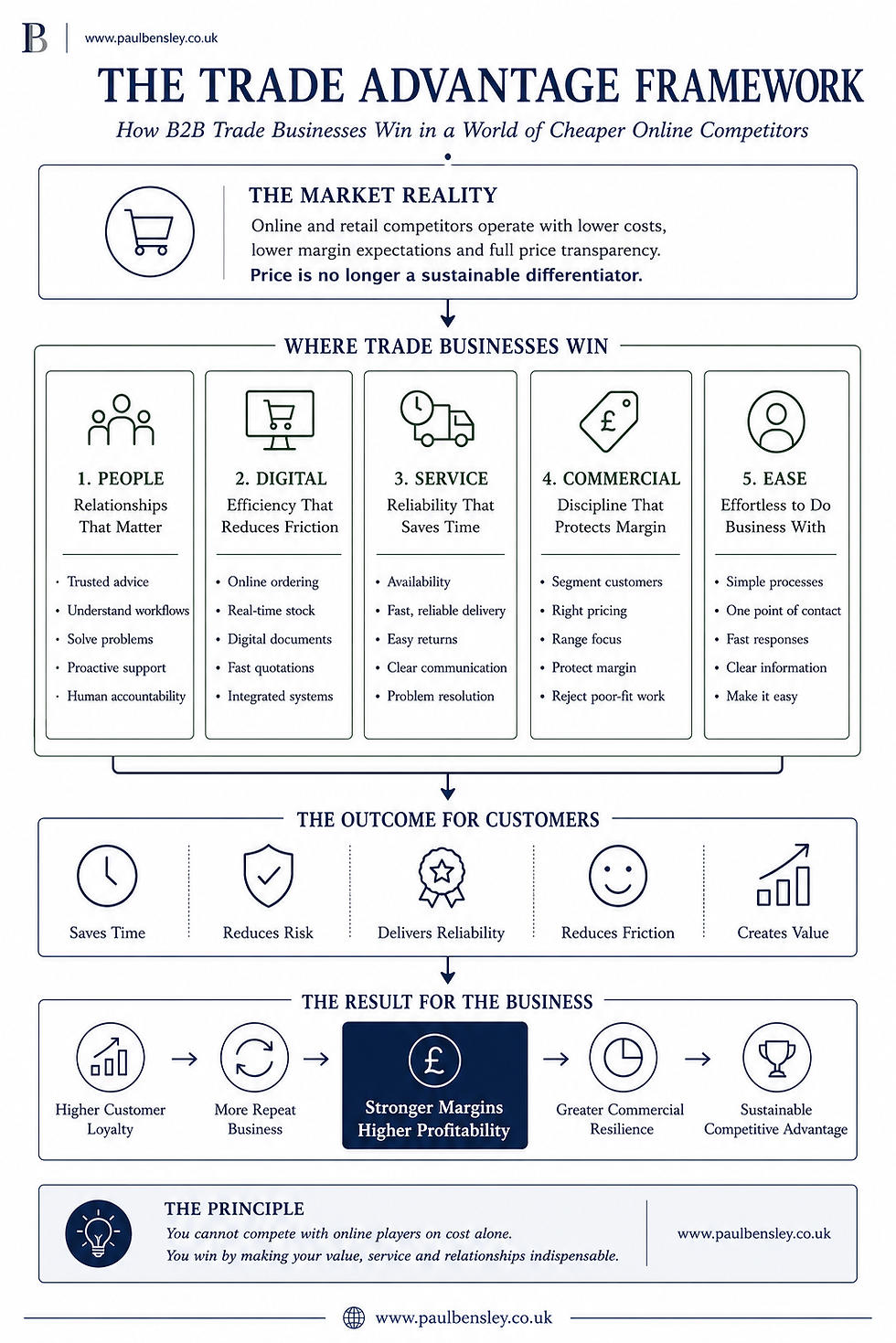
1. Compete on total value, not unit price
Online comparison focuses on line-item price.
Trade businesses should focus on:
Availability when needed
Same-day or timed delivery
Technical support
Credit terms
Returns flexibility
On-site problem solving
But there is something even more powerful.
Ease of doing business.
Ease of doing business is a competitive weapon
In trade markets, time is money.
Friction is expensive.
Customers will often tolerate a premium if you make their working life easier.
Ease of doing business includes:
Fast quotations
Clear pricing
Reliable stock visibility
Simple returns
Quick dispute resolution
One point of contact
Proactive communication
When working with you feels effortless, price sensitivity reduces.
When working with you feels complicated, price becomes the only differentiator.
The Magic 20 principle
Over the years I have found, loosely rooted in behavioural psychology, that most buyers are prepared to pay around 20 percent more if they genuinely believe they are receiving at least 20 percent more value.
It is not a precise scientific rule and I have long since lost the original reference, but commercially it holds surprisingly true.
Ease of doing business, reliability and expertise often form that additional 20 percent.
Beyond that threshold, resistance increases.
Below it, price comparison dominates.
If you cannot demonstrate additional value clearly, retail and online will win.
2. People are a commercial differentiator
All things being equal, people matter.
In trade markets especially, relationships carry weight.
Customers will often pay a few percent more if:
They trust the individual
They feel understood
They know issues will be resolved quickly
They value the relationship
A knowledgeable branch manager who knows a contractor’s workflow.
An account manager who anticipates seasonal demand.
A credit controller who handles issues pragmatically.
These are not soft factors.
They reduce friction. They reduce risk. They protect margin.
Retail and online struggle to replicate accountable human relationships at scale.
If your people are disengaged, online wins.
If your people are trusted and proactive, price becomes one factor among many.
3. Blend digital efficiency with human strength
Digital is not optional.
But digital alone is not enough.
Winning trade businesses combine:
Online ordering
Real-time stock visibility
Digital invoicing
CRM insight
With:
Human accountability
Relationship management
Project understanding
Frictionless and human is a powerful combination.
4. Curate your range intelligently
Retailers and online marketplaces carry everything.
Trade businesses should carry what matters most to their core segments.
Remove low-margin slow-moving lines
Focus on high-demand items
Align range to your strongest customer base
Seek supplier partnerships or exclusivity
Focus strengthens service and protects margin.
5. Segment and protect margin
Not every customer is yours to win.
Segment clearly:
Strategic accounts
Convenience buyers
Pure price-driven customers
Some customers will always choose the cheapest option.
Let them.
Trying to retain every customer at any cost weakens the entire structure.
Checklist: Are We Built to Compete in a Blurred Market?
Are we genuinely easy to do business with?
Is friction actively measured and reduced?
Are our people trained to add value?
Can we justify a premium clearly?
Is digital integrated without losing relationship strength?
Are we disciplined on pricing by segment?
Are we clear where retail and online compete directly with us?
If these answers are unclear, margin pressure will intensify.
If they are disciplined, transparency becomes manageable rather than threatening.
The reality
Retail encroachment and online transparency are structural.
They are not temporary cycles.
The trade businesses that survive will not be the cheapest.
They will be:
Easier to deal with
Faster to respond
More knowledgeable
More disciplined commercially
More relational
Price transparency is permanent.
Advantage must therefore be intentional.
Final thought
In transparent markets, friction becomes expensive.
Relationships become valuable.
Commercial discipline becomes essential.
The businesses that win will combine technology, expertise and pricing clarity with people customers genuinely want to work with.
In my other articles on my website and here on LinkedIn, I explore pricing discipline, revenue quality, commercial turnarounds and growth leadership. The consistent theme is simple: sustainable advantage is built deliberately through commercial clarity, not reactive discounting.
If you found this article useful, you may also enjoy:
FAQs:
How can traditional B2B businesses compete with cheaper online competitors?
Traditional B2B businesses should avoid trying to beat online competitors purely on price unless they have the cost structure to sustain it. Instead, they need to identify where they create additional customer value through availability, expertise, service, reliability, convenience, relationships, technical support and reduced risk. The objective is to make the buying decision about more than the headline price.
Why are online competitors often cheaper than traditional businesses?
Online competitors can sometimes operate with lower property, staffing, sales and service costs, allowing them to offer lower prices. Their operating model may also be designed around standardised transactions rather than providing the broader service infrastructure of a traditional trade business.
Can traditional B2B distributors survive ecommerce?
Yes, but simply protecting the traditional model is unlikely to be enough. B2B customers increasingly expect the convenience and transparency they experience when buying online elsewhere. Traditional distributors need to combine their existing strengths with better digital convenience and a clearer value proposition.
Should B2B businesses match online competitors' prices?
Not automatically. Matching every lower online price can destroy margin without addressing why customers are considering the competitor. Leaders should first determine whether the customer sees meaningful additional value in their proposition. Where little additional value exists, the business may need to change the proposition rather than simply defend the price.
How can B2B businesses differentiate themselves from online competitors?
Differentiation can come from technical expertise, product availability, dependable delivery, problem-solving, account support, credit, returns, advice, aftersales service and reduced customer risk. The important question is which of these genuinely matter to the target customer rather than assuming every service creates value.
Do B2B customers still value relationships?
Yes, particularly when purchases involve complexity, risk or significant commercial consequences. However, a relationship alone is rarely enough to justify a permanently uncompetitive proposition. Strong B2B relationships create greater value when they are combined with expertise, reliability, understanding and easier ways of doing business.
How has ecommerce changed B2B customer expectations?
Ecommerce has increased expectations around price transparency, availability, speed, convenience and ease of ordering. B2B customers increasingly compare their trade-buying experience with the simplicity of consumer ecommerce, putting pressure on traditional businesses with slow or complicated purchasing processes.
Is price the main reason B2B customers buy online?
Not always. Price is important, but customers may also move online because purchasing is faster, easier and more transparent. If buying from a traditional supplier involves unnecessary calls, emails, waiting for quotations or uncertainty over availability, convenience itself becomes a competitive advantage for the online alternative.
How can trade businesses add value beyond the product?
Look at the customer's entire buying and usage journey. Businesses can create value by making products easier to select, order, receive, use and replace. Technical advice, dependable availability, faster problem resolution and reduced downtime can all create value even when competitors sell essentially the same product.
What is the role of branches in the future of B2B trade?
Branches need to create value beyond simply being locations where products are stored and collected. They can provide immediate availability, expertise, problem-solving, convenience and local service. Where a branch does not create value beyond what customers can obtain online, its role becomes increasingly difficult to justify.
Should traditional B2B businesses invest in ecommerce?
For many businesses, yes. Digital channels should not necessarily replace branches, salespeople or customer service. Instead, ecommerce can remove friction from routine transactions while people focus on areas where expertise, relationships and judgement add greater value.
What should B2B salespeople do when customers can find cheaper prices online?
Salespeople need to move beyond defending the price. They should understand why the customer is considering the alternative, what matters in the purchasing decision and what economic value the wider proposition provides. If the only meaningful difference is price, the salesperson has very little with which to compete.
How can B2B businesses demonstrate value instead of just claiming better service?
Translate service into outcomes the customer can recognise. Instead of saying “we provide better service”, demonstrate how the proposition reduces downtime, saves labour, improves availability, prevents mistakes, simplifies purchasing or reduces risk. Value becomes more persuasive when the customer can understand its commercial consequence.
What is total cost of ownership in B2B purchasing?
Total cost of ownership considers the wider cost of buying and using a product rather than only its purchase price. Delivery, downtime, product life, maintenance, failure, labour, returns and administrative effort can all affect the true cost. A cheaper purchase price does not necessarily mean a lower overall cost.
Can digital and traditional sales channels work together?
Yes. The strongest model may be omnichannel rather than online versus offline. Customers can use digital channels for speed and convenience while accessing people when they need expertise, advice or help solving a more complicated problem.
How can B2B businesses protect gross margin from online price competition?
Businesses need to understand where they genuinely create differentiated value, segment customers according to their needs and avoid applying the same service model to everyone. They should also examine pricing discipline, cost-to-serve and whether expensive services are being provided to customers who do not value them.
How should B2B businesses respond to increasing price transparency?
Price transparency makes it harder to rely on inconsistent pricing or information advantages. Businesses need a clearer explanation of why their proposition is worth its price, supported by stronger pricing discipline and a better understanding of which customers value which elements of the proposition.
Will online competitors eventually replace traditional B2B distributors?
Not necessarily, but they will continue to expose parts of traditional business models that no longer create enough customer value to justify their cost. The likely winners are businesses that combine digital convenience with the human expertise, service and reliability that genuinely matter to customers.
What is the biggest mistake traditional B2B businesses make when responding to online competition?
One of the biggest mistakes is treating online competition simply as a pricing problem. Lower prices may be the visible symptom, but the deeper challenge can be convenience, transparency or a traditional cost structure supporting services customers no longer value. Cutting prices without addressing those issues can reduce margin while leaving the underlying competitive problem unchanged.


Comments