How CEOs Should Measure AI ROI and Financial Return

Updated: Aug 27
AI investment is moving quickly from experimentation to expectation. Businesses are buying licences, integrating AI into existing systems, developing internal tools and encouraging employees to find ways of using it in their everyday work.
Eventually, somebody has to ask the obvious question:
What financial return are we getting from it?
That sounds straightforward, but measuring AI ROI and establishing the genuine financial return from AI is surprisingly difficult.
A business can measure how many employees are using AI, how many processes have been automated and even how many hours employees believe they are saving. None of those measures necessarily tells a CEO whether the investment has improved the financial performance of the business.
This is where I think leadership teams need to become more disciplined.
AI adoption is not the objective. Business performance is.
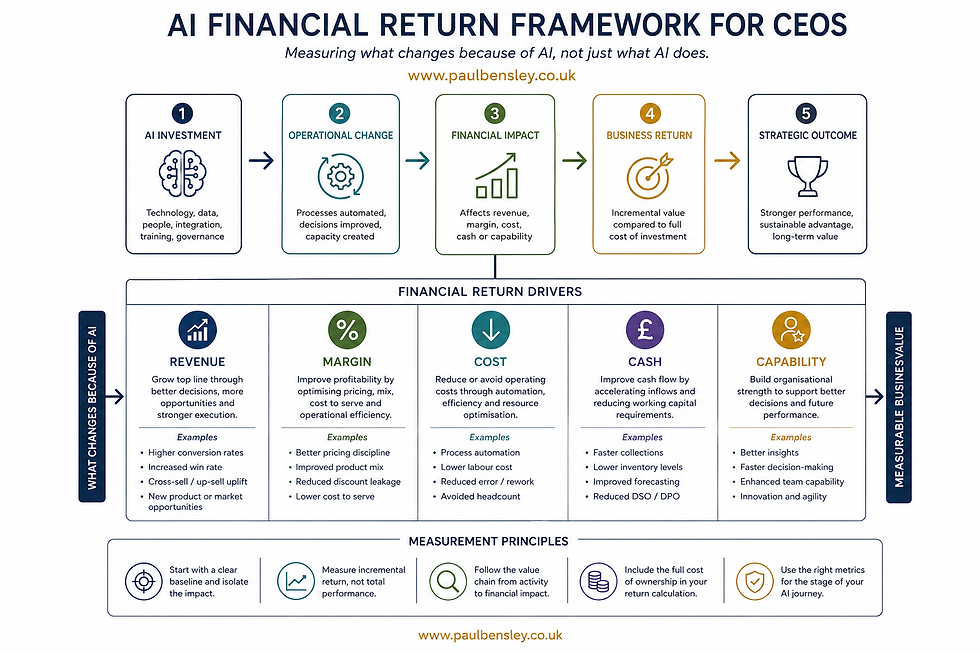
The question isn't whether your business is using AI. It's whether AI is improving revenue, margin, cost, cash or capability.
And when it comes to measuring return, I would add another principle:
Don't measure what AI does. Measure what changes because of it.
The Problem With Measuring Hours Saved
The easiest AI benefit to measure is usually time. Ask someone how long a task took before AI, measure how long it takes afterwards and calculate the difference. If 500 employees each save two hours per week, the resulting number quickly becomes impressive.
The problem comes when businesses convert those hours directly into pounds.
Imagine an employee costs the business £40 per hour and AI saves them five hours each week. It is tempting to say AI has generated £200 of weekly savings, or roughly £10,000 per year.
But has it?
If that employee remains on exactly the same salary, working exactly the same number of hours, the business hasn't actually saved £10,000. It has created approximately 250 hours of additional annual capacity.
That capacity might eventually be worth considerably more than £10,000, or considerably less. The financial result depends on what happens to it.
If the employee uses those hours to generate additional profitable revenue, there is a return. If the business can absorb growth without recruiting another employee, there is a return. If external expenditure can be removed, there is a return. If the person simply becomes slightly less busy, there may be an employee benefit, but there isn't necessarily a measurable financial return.
This is why CEOs should be cautious when presented with large AI savings calculations based predominantly on employee hours.
Time saved is evidence of productivity. It isn't automatically evidence of financial return.
Separate Capacity From Financial Value Ai ROI
I think businesses should distinguish between three types of productivity benefit: capacity created, cost avoided and cost removed.
Capacity created means AI allows people to complete the same amount of work in less time. The economic value exists as potential, but the P&L may remain unchanged.
Cost avoided is different. Imagine a growing business expects to recruit five additional customer service employees over the next two years. AI allows the existing team to support that growth without those hires. No current employee has disappeared, but a future cost the business expected to incur has been avoided.
Cost removed is the clearest financial impact. Perhaps AI replaces an outsourced process, eliminates software expenditure, reduces overtime or allows a genuine structural change to the cost base. The expense actually disappears from the P&L.
All three matter, but they shouldn't be added together as though they are equivalent. A board needs to know whether an AI initiative has created theoretical capacity, avoided a future cost or genuinely reduced current expenditure.
That distinction alone would improve the quality of many AI business cases.
Start With a Baseline
You cannot credibly measure improvement if you don't know where you started.
Before implementing a significant AI initiative, establish the baseline. If AI is intended to improve quotation conversion, what is conversion today? If it should reduce customer service costs, what is the current cost per enquiry? If the objective is to improve gross margin, what is the existing realised margin? If it should accelerate credit collection, what are debtor days before implementation?
This sounds obvious, but it is easily overlooked when businesses become excited about implementation.
The baseline also needs to be specific enough to isolate what changed. Looking at total company revenue before and after introducing an AI sales tool tells you very little because hundreds of other factors could have influenced the result.
A much better measure might be the conversion rate of AI-supported opportunities compared with an appropriate baseline, or the change in purchasing behaviour of customers identified by an AI retention model.
The closer the measure sits to the intervention, the easier it becomes to understand whether AI actually contributed to the result.
Measure the Business Outcome, Not the AI Activity
This is where I would change many AI dashboards.
A dashboard might currently tell the CEO that 72% of employees are active AI users, 14,000 prompts were submitted last month and 35 processes now contain some form of AI automation.
Interesting, perhaps. Financially meaningful, not necessarily.
If the business has invested £1 million in AI, I would want to know what changed.
Did sales conversion improve? Did customer attrition fall? Did gross margin increase? Did the cost of serving customers reduce? Was additional recruitment avoided? Did working capital improve? Did output increase without a corresponding increase in overhead?
Those measures tell you something about the business.
This is why “Don't measure what AI does. Measure what changes because of it” is such an important principle. AI activity is only valuable when it produces an operational change, and that operational change only produces financial value when it affects something economically meaningful.
Follow the Value Chain
I think CEOs should require significant AI investments to explain a relatively simple chain:
AI Investment → Operational Change → Financial Impact → Business Return
Take an AI sales application as an example. The investment might provide salespeople with automated account research and identify potential opportunities before customer meetings. The operational change is better preparation and more selling capacity. The financial impact might be increased opportunity creation or improved conversion, which ultimately creates incremental gross profit.
Now consider an AI reporting tool. It reduces monthly reporting from 100 hours to 30 hours. The operational improvement is clear: 70 hours of capacity have been created. But the financial impact remains unproven until the organisation explains what happens to those 70 hours.
The technology worked in both examples.
Only one has necessarily demonstrated a financial return.
That is why measuring the operational improvement and stopping there isn't enough.
Revenue Should Be Measured Through Contribution, Not Just Sales
If AI generates additional revenue, it can be tempting to report the entire revenue increase as the benefit.
CEOs and CFOs should go further.
Imagine AI-supported sales activity produces £1 million of additional revenue. If the contribution margin on that business is 30%, the initial economic benefit is closer to £300,000 before considering any additional operating costs required to deliver it.
If servicing the additional revenue requires £100,000 of extra labour, logistics or support, the financial contribution becomes smaller again.
This matters because AI programmes can otherwise create impressive-looking revenue numbers without explaining how much of that revenue actually reaches profit.
The same applies to customer retention. Preventing £500,000 of revenue from disappearing can be extremely valuable, but the economic value is the contribution protected rather than simply the revenue retained.
For CEOs trying to understand AI return, follow the money far enough down the P&L.
Margin Improvement Can Be Easier to Prove
Some AI initiatives may have a much cleaner financial relationship.
Suppose AI identifies inconsistent discounting across a customer base and commercial teams subsequently improve realised gross margin by 0.5 percentage points. If the relevant revenue base is £100 million, that improvement represents £500,000 of additional gross profit, assuming volumes and other factors remain constant.
The measurement chain is relatively straightforward.
The same principle could apply to freight recovery, purchasing, rebates, product mix or cost-to-serve. If AI identifies an opportunity, management acts on it and the resulting margin improvement can be observed, the financial return becomes much easier to demonstrate.
This is one reason I think margin intelligence could become one of the most valuable applications of AI in established businesses. It doesn't necessarily require AI to make commercial decisions. It requires AI to identify patterns and anomalies at a scale humans struggle to analyse continuously.
People still make the decision.
AI improves the information surrounding it.
Don't Forget Cash
Not every worthwhile AI return needs to appear in EBITDA.
If AI helps a business reduce inventory, improve collections or manage working capital more effectively, the benefit may appear first in cash rather than profit.
Imagine an AI-supported inventory process allows a company to reduce average stockholding by £2 million without affecting customer service. The P&L impact may initially be relatively small, but releasing £2 million of cash is clearly economically valuable.
This is why I use revenue, margin, cost, cash and capability when thinking about AI business performance rather than focusing solely on cost savings.
Different AI initiatives create value in different places.
The CEO's job is to understand where the value should appear and make sure the organisation measures the appropriate outcome.
Capability Is Harder to Measure, but Still Matters
Capability is probably the most difficult category to convert into a traditional ROI calculation.
How much is it worth if managers make better decisions? What is the return from a salesperson being able to understand an unfamiliar market in an hour rather than a day? How do you value a finance team being able to analyse scenarios it previously didn't have the capacity to investigate?
Trying to attach an artificial pound value to every one of these improvements can create false precision.
Sometimes the right approach is to measure the operational improvement first and then look for evidence of downstream financial impact over time.
If AI improves sales preparation, measure whether meeting activity, opportunity creation or conversion subsequently changes. If it improves management analysis, look at whether decision cycles shorten or forecast accuracy improves.
Not every benefit needs an immediate financial value attached to it.
But there should still be a hypothesis explaining why the capability matters to the business.
Measure Incremental Return, Not Total Performance
Another challenge is attribution.
If revenue grows by 10% after an AI tool is introduced, AI didn't necessarily cause the 10% increase. Pricing may have changed, the market may have improved, a competitor may have exited or the sales team may simply have performed better.
This is where businesses need to avoid giving AI credit for everything that happens after implementation.
Where possible, compare AI-supported activity against a meaningful baseline. That might involve comparing similar teams, customer groups, processes or periods. In larger organisations, controlled pilots can be particularly useful because they provide a much clearer view of incremental impact before an AI solution is scaled.
You don't need academic perfection.
But you do need enough discipline to answer:
“What would probably have happened without this investment?”
The difference between that scenario and what actually happened is much closer to the genuine incremental value.
Include the Full Cost of AI
Return calculations also become misleading when businesses measure benefits carefully but ignore significant parts of the investment.
The cost isn't simply the AI licence.
There may be implementation costs, integration, consulting, data preparation, employee training, governance, security, additional computing requirements and ongoing management. Internal employee time spent building and maintaining the solution has an economic cost too, even if it doesn't appear as a new invoice.
A £100,000 AI platform that requires £300,000 of implementation and support shouldn't be assessed as a £100,000 investment.
This sounds basic, but AI projects can accumulate hidden costs surprisingly quickly, particularly once organisations move from experimenting with general-purpose tools towards integrating AI into business processes.
The financial return should therefore compare incremental economic benefit against the full incremental cost of creating it.
Use Different Measures at Different Stages
One mistake would be expecting every AI experiment to demonstrate EBITDA immediately.
Early-stage experiments need different measures from scaled investments.
During experimentation, I would be comfortable measuring whether the technology works, whether employees can use it, whether quality is acceptable and whether there appears to be a meaningful operational benefit. The objective is learning, and the investment should normally be relatively small.
Once an initiative moves towards implementation, the measurement needs to become more demanding. What operational KPI should change? What financial outcome should follow? How long should that take?
Once AI is deployed at scale, the financial expectation should be clearer again. At that point, the organisation should be able to demonstrate whether the original business case is materialising.
The mistake isn't experimenting without an immediate financial return.
The mistake is continuing to fund something at scale because people are using it without establishing whether it creates sufficient value.
A Simple CEO AI Return Scorecard
I would keep the board-level measurement relatively simple. For each significant AI initiative, I would want six things:
Investment: What have we actually spent, including implementation and ongoing cost?
Baseline: What happened before AI?
Operational impact: What has measurably changed?
Financial impact: Has that change affected revenue, margin, cost or cash?
Capability impact: What can the organisation now do that it couldn't do before?
Return: How does the financial value compare with the investment, and how confident are we that AI contributed to it?
That final point matters. A £1 million theoretical benefit with very weak evidence of causation shouldn't be presented with the same confidence as £500,000 of directly measurable cost removed from the P&L.
I would rather see a board presented with a credible range and clear assumptions than an impressive number built on false precision.
The Question CEOs Should Keep Asking
AI is going to become embedded in more and more of how businesses operate.
Eventually, distinguishing between an "AI process" and an ordinary business process may become increasingly meaningless.
But we aren't there yet.
For now, organisations are making substantial investments in AI and leadership teams need to know whether those investments are creating value. Adoption metrics, productivity estimates and demonstrations of technological capability can all help explain what is happening, but they shouldn't be confused with financial return.
The discipline is to keep following the chain.
What did AI change operationally? What happened financially because of that change? What did it cost us to create the improvement? And how confident are we that the result wouldn't have happened anyway?
That is a much harder conversation than reporting the number of AI users.
It is also a much more useful one.
AI adoption is not the objective. Business performance is.
The question isn't whether your business is using AI. It's whether AI is improving revenue, margin, cost, cash or capability.
And when somebody tells you AI has saved the business £5 million, there is one final question every CEO should ask:
“Where can I see it?”
Further Reading:
FAQs
What is AI ROI?
AI ROI measures the business value created by an AI investment relative to its total cost. For business leaders, this should go beyond measuring adoption, usage or time saved. The more important question is whether AI is improving revenue, margin, cost, cash or organisational capability.
How should CEOs measure the ROI from AI?
CEOs should connect AI initiatives to measurable business and financial outcomes. Rather than stopping at metrics such as hours saved or number of users, leaders should trace the impact from the AI use case through operational improvement, business drivers and ultimately financial performance.
What metrics should businesses use to measure AI ROI?
The right metrics depend on the purpose of the AI initiative. Useful measures can include productivity, conversion rates, customer retention, pricing performance, gross margin, cost-to-serve, headcount avoidance, working capital and ultimately EBITDA. The important principle is to measure the business outcome, not simply the AI activity.
Why doesn't AI productivity automatically increase EBITDA?
Saving time does not automatically create financial value. If AI saves employees several hours but the released capacity is simply absorbed by other activity, there may be no direct improvement in profit. Financial value appears when productivity is converted into higher output, additional revenue, lower cost, avoided expenditure or another measurable business benefit.
What is the AI-to-EBITDA Framework?
The AI-to-EBITDA Framework, developed by Paul Bensley, is a business performance framework designed to connect AI initiatives with measurable financial outcomes. It traces value through five stages: AI Use Case → Operational Impact → Business Driver → Financial Conversion → EBITDA Impact.
What is the difference between AI ROI and AI adoption?
AI adoption measures whether people are using AI. AI ROI measures whether that use is creating meaningful business value. High adoption can be positive, but widespread use of AI does not necessarily mean the organisation is improving revenue, margin, cost, cash or capability.
How can a business calculate the financial return from AI?
Start by establishing the cost of the AI initiative and identifying the operational change it is expected to create. Then determine how that change affects a financial driver such as revenue, margin or cost. Compare the measurable financial benefit with the total cost of implementation, technology, training and ongoing operation.
How long should it take for an AI investment to demonstrate ROI?
There is no universal timeframe because AI initiatives vary significantly in complexity and purpose. Leaders should establish expected operational and financial outcomes before implementation, define when those measures will be reviewed and identify early indicators that show whether the initiative is moving towards financial value.



Comments