AI Adoption Is Not the Goal. Business Performance Is
Updated: Aug 27
There is a strange question being asked in boardrooms at the moment: “How much AI are we using?”
As AI adoption accelerates, businesses are measuring licences purchased, employees trained, prompts submitted, processes automated and the percentage of employees regularly using AI tools. Those numbers can tell you whether people are experimenting with the technology, but they tell you remarkably little about whether AI is actually improving business performance.
Businesses are measuring licences purchased, employees trained, prompts submitted, processes automated and the percentage of employees regularly using AI tools. Those numbers can tell you whether people are experimenting with the technology and whether adoption is spreading, but they tell you remarkably little about whether the business itself is actually getting better.
Buying licences isn't an outcome, and neither is running AI workshops, automating processes or achieving an 80% adoption rate. All of those things can be useful indicators that an organisation is embracing the technology, but none tells us whether that investment is improving business performance.
AI adoption is not the objective. Business performance is.
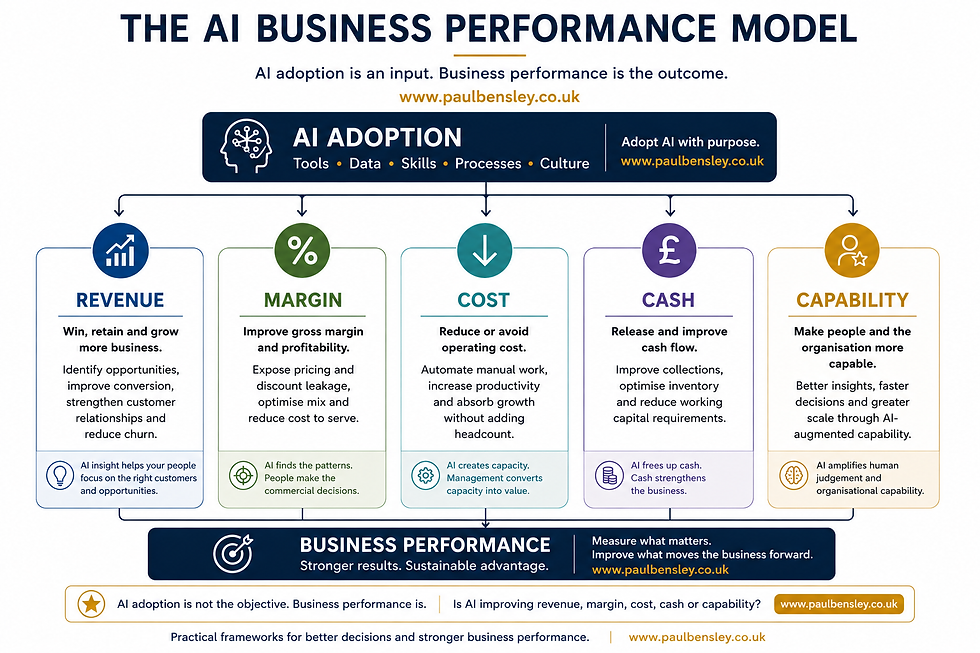
The question isn't whether your business is using AI. It's whether AI is improving revenue, margin, cost, cash or capability.
I think that distinction is becoming increasingly important. There is understandable pressure on leadership teams to demonstrate that their organisations are embracing AI, particularly when almost every conference, consultancy report and technology company is warning about the consequences of being left behind.
The danger is that activity starts to become confused with progress, and AI becomes something businesses feel they need to demonstrate they are doing rather than something they use to solve specific business problems.
We Have Seen This Before
Businesses have a habit of turning methods into objectives. Digital transformation became an objective. Agile became an objective. CRM implementation became an objective. Customer experience programmes, lean initiatives and countless other management ideas have followed a similar path.
Something begins as a means of improving the organisation and gradually becomes something the organisation believes it needs to demonstrate that it is doing.
AI is particularly vulnerable to this because there is genuine anxiety about being left behind. Leaders are constantly being told that AI will transform industries, eliminate jobs, create new business models and separate tomorrow's winners from its losers. Some of that will undoubtedly happen, but fear of being left behind isn't a particularly good investment methodology.
When everybody around you is talking about AI, simply doing something can feel safer than doing nothing. That creates pressure to purchase technology, launch programmes and announce initiatives before the business has clearly defined what improvement it expects those investments to create.
I would start somewhere much less exciting: what are we actually trying to make better?
Start With the Business, Not the Technology
This is something I keep coming back to when talking to businesses about AI. Don't start by asking what AI can do. Start by asking what the business needs.
Where are customers leaving? Where are sales opportunities being missed? Where is gross margin leaking? Which costs are increasing faster than revenue? Where is cash unnecessarily tied up? Which processes consume enormous amounts of time? Where are capable people doing work that doesn't require their capability, and where are managers making decisions without access to the information they really need?
Once you start with those questions, AI becomes a means of improving the business rather than an objective in itself. You aren't searching for somewhere to deploy a new technology; you are starting with a known business problem and asking whether AI can help solve it.
The sequence becomes:
Business Problem → AI Intervention → Operational Improvement → Business Performance
Rather than:
AI Tool → Adoption → Search for a Use Case → Hope for Value
That small change forces AI investment to begin with an outcome rather than the technology. It also makes prioritisation much easier because you can compare potential AI projects based on the importance of the business problem they address rather than how sophisticated or interesting the technology appears.
Five Places I Would Look for AI Adoption Value
If I were sitting with a leadership team trying to understand whether its AI investment was genuinely improving the organisation, I wouldn't begin with an adoption dashboard. I would look at five things: revenue, margin, cost, cash and capability.
Together, they provide a simple way of moving the conversation away from technology and towards business performance. Not every AI initiative needs to affect all five, and some benefits will take longer to materialise than others, but a meaningful AI investment should eventually be capable of explaining which of them it is trying to improve.
Revenue
Can AI help the organisation win, retain or grow more business? That might mean identifying customers whose spending is beginning to decline, finding cross-sell opportunities, improving lead qualification, helping salespeople prepare for meetings, analysing lost quotations or improving the speed and quality of customer follow-up.
A salesperson managing 150 accounts cannot continuously analyse every transaction, quotation, product category and purchasing pattern across their customer base. The information might all exist, but the human effort required to find the patterns means many of them remain invisible until the opportunity has disappeared or the customer has already left.
AI can help surface the accounts that deserve attention and leave the salesperson to decide what to do about them. This is something I often tell businesses: AI doesn't always need to make the commercial decision. Sometimes it simply needs to tell the person where to look.
That distinction matters. The value doesn't necessarily come from removing the salesperson from the process; it comes from helping them spend more of their time on the customers and opportunities where their judgement, experience and relationships can create the greatest return.
Margin
Margin is potentially an even bigger AI opportunity, and one I think receives far less attention than productivity. Margin leakage rarely comes from one enormous mistake. It accumulates through thousands of smaller decisions: slightly too much discount, old prices left unchanged, unnecessary freight, inconsistent rebates, changing product mix and customers whose apparent value disappears once their true cost to serve is understood.
The challenge is that these patterns can be extremely difficult for people to identify across thousands or millions of transactions. AI is particularly useful where the business has enough data for patterns to exist but too much data for people to analyse continuously.
Why is one customer receiving a 14% discount when similar customers receive 8%? Why has the realised selling price of a product fallen while input costs have increased? Which accounts are approaching renewal materially below target margin? Which salespeople consistently override recommended pricing, and what happens to profitability when they do?
AI doesn't need control of pricing to create value. It can identify the anomaly, provide the context and allow a commercial person to decide what action is appropriate. Some of the most valuable uses of AI may therefore involve asking it to notice something rather than do something.
Cost
Cost is where most AI conversations naturally begin because productivity improvements are relatively easy to demonstrate. A report that previously took four hours can be produced in one. Customer emails can be drafted faster, meeting notes summarised automatically and administrative processes completed with considerably less human effort.
There is genuine value in that, but businesses need to measure it honestly. If AI reduces a task from 40 hours to ten and the same employees remain employed on the same salaries, the business hasn't automatically saved 30 hours of cost. The operating expense appearing in the P&L hasn't changed.
What AI has created is capacity, and that capacity only becomes financially valuable when management does something with it. Perhaps the team can absorb growth without recruiting another person, external support can be reduced, roles can be redesigned or employees can spend more time on work that creates revenue or improves customer experience.
This is why I think businesses need to distinguish between capacity created, cost avoided and cost removed. All three can be valuable, but they aren't the same thing. Multiplying theoretical hours saved by employee hourly rates might produce an impressive number for an AI presentation, but unless something subsequently changes in the business, it isn't necessarily a financial return.
AI creates capacity. Management converts capacity into value.
Cash
Cash receives surprisingly little attention in conversations about AI, particularly when compared with productivity, but there are significant opportunities here too. Could AI identify deteriorating customer payment behaviour before an account becomes a serious debtor? Could it help credit control teams prioritise the accounts most likely to require human intervention? Could better demand analysis reduce unnecessary inventory or identify purchasing patterns that are tying up working capital?
The same principle applies to stock. A business might hold thousands of product lines across multiple locations, with purchasing decisions influenced by seasonality, lead times, customer behaviour and historical demand. AI's ability to analyse those patterns could help identify slow-moving inventory, unusual stock accumulation or areas where working capital is being consumed without sufficient return.
These may not be the AI applications that generate the most excitement at a conference, but that isn't the point. Releasing £1 million of unnecessary working capital could be considerably more valuable to a business than generating emails 30% faster.
The technology doesn't need to look impressive. The outcome does.
Capability
The fifth category is different because its financial impact isn't always immediately visible. AI can make capable people more capable, allowing employees to analyse more information, prepare more effectively and complete work that previously required specialist support or considerably more time.
A salesperson can understand an unfamiliar account faster. A finance manager can interrogate information that previously required hours of spreadsheet analysis. A manager preparing for a difficult conversation can use AI to challenge their thinking and consider how the other person might respond. A leader considering an investment can ask AI to test assumptions, identify missing risks and explore alternative scenarios before making the decision.
The employee hasn't disappeared. Their capability has increased.
I think this becomes increasingly important as access to intelligence gets cheaper. If competitors have access to broadly similar AI technology, simply possessing the technology isn't going to create a sustainable advantage. Competitive advantage will increasingly come from what organisations and their people learn to do with it.
The Productivity Trap
Productivity deserves particular attention because it is probably the easiest AI benefit to demonstrate and therefore the easiest one to overstate.
Ask an employee how long a task used to take and how long it takes with AI, multiply the difference across a year and then multiply those hours by an employment cost. Suddenly an AI programme appears to have generated millions of pounds of savings.
Except those millions may never appear anywhere in the accounts.
Imagine a finance team produces a monthly report that requires 40 hours of work. AI reduces that to ten. It is tempting to claim a 30-hour saving, but if the same people remain employed on the same salaries, no cost has actually left the P&L. The business has created 30 hours of capacity, which may be extremely valuable, but it needs to be described accurately before it is counted as a saving.
The team might use that capacity to perform analysis it previously didn't have time to complete. The business might grow without needing the additional finance employee it expected to recruit next year.
External analytical support might be reduced, or roles might be redesigned around judgement rather than assembling information. Each of those can create genuine financial value, but the benefit comes from what management does after AI creates the capacity.
That distinction is important because otherwise organisations risk building AI business cases around theoretical savings that never become financial results.
Adoption Still Matters, but It Isn't the Outcome
None of this means businesses should ignore adoption. If you have invested in technology and nobody is using it, that is clearly a problem.
Usage can help identify where employees need training, where tools are failing to gain traction and where particular teams have discovered valuable applications that could be shared elsewhere.
The mistake is treating adoption as the end measure rather than an input into something more important.
Imagine two businesses. Company A has purchased AI licences for 1,000 employees and 800 use them every week, allowing the organisation to proudly report an 80% adoption rate. Company B has far fewer regular users, but those employees are using AI to improve quotation conversion, identify customers at risk of leaving, expose pricing inconsistencies and allow the organisation to absorb growth without additional administrative headcount.
Which business has the better AI strategy?
You would need to see the financial results to answer that properly, but I know which one I would investigate first. The second company is attempting to connect AI usage with measurable business outcomes rather than assuming usage itself demonstrates success.
Adoption is an input. Performance is the outcome.
Stop Asking Departments What AI They Want
Another approach I would challenge is asking every department to identify its own AI use cases.
It sounds sensible and will undoubtedly generate ideas, but it can also create a long shopping list of things people would like AI to do without any clear relationship to the priorities of the business.
I would turn the exercise around and give teams the important business problems first.
Revenue in this segment is declining. Gross margin has fallen by two points. Working capital is increasing. Customer service costs are growing faster than sales. Quotation conversion has deteriorated. The business expects to need another ten administrative employees over the next two years.
Then ask a different question:
“Could AI materially change any of these?”
Now the organisation is searching for AI applications against known business priorities. Instead of collecting 100 disconnected use cases and deciding which ones sound most innovative, you can rank opportunities based on potential financial value, feasibility and risk.
That creates a very different AI roadmap.
AI Doesn't Need to Be Impressive to Be Valuable
There is another bias worth recognising. The more sophisticated an AI application appears, the more important it can feel. An autonomous agent completing an entire workflow sounds much more transformational than a simple system that identifies customers whose purchasing behaviour has changed.
But complexity and value are not the same thing.
Imagine an AI system that automatically produces a management report and releases 30 hours of capacity every month. Useful. Now imagine a much simpler model that reviews customer purchasing behaviour every Monday and identifies ten accounts showing signs of decline. The sales team intervenes and prevents £500,000 of profitable revenue from disappearing.
The second application may use less sophisticated technology and receive far less attention internally, but it could create considerably more value.
The best AI use case isn't necessarily the most impressive one. It is the one that creates the most useful change in business performance.
That principle should influence how AI projects are prioritised, funded and measured.
Measure AI Like Any Other Investment
I suspect AI will eventually lose some of its mystique. Businesses won't have an "AI strategy" in the same way most organisations no longer talk about having an "internet strategy". AI will simply become embedded in how work gets done, information is analysed, customers are served and decisions are supported.
Until then, leadership teams should resist giving AI investments a different standard from everything else. The technology may be new, but the investment questions aren't.
What problem are we solving? What does success look like? What operational measure should change? What financial measure should change? What will it cost? What risks are we introducing? How quickly will we know whether it works?
I would add one more question that I think is particularly important:
What happens if it works?
If AI releases 20% of a team's capacity, what are you going to do with it? If it identifies £1 million of potential cross-sell opportunities, who is responsible for converting them? If it exposes pricing inconsistencies, who changes the pricing? If it identifies inventory unnecessarily consuming cash, who acts on that information?
AI can create insight and capacity remarkably quickly. Organisations still need management to turn those things into results.
A Better AI Dashboard
If I were designing an AI dashboard for a leadership team, I would still include adoption, usage and training, but I wouldn't put them at the top. I would begin with the measures that tell me whether the business is changing.
Revenue influenced: How much revenue has been won, retained or expanded through AI-supported activity?
Margin improved: Where has AI identified pricing, discount, product mix or cost-to-serve opportunities, and what happened after people acted on them?
Cost removed or avoided: What expenditure has genuinely disappeared from the P&L, and what future expenditure has the organisation avoided?
Cash released: Has AI contributed to improvements in working capital, collections, inventory or other areas affecting cash?
Capability created: What can employees or teams now do faster, better or at greater scale than they could previously?
Underneath those measures I would look at adoption, usage and training. They still matter, but that hierarchy keeps the organisation focused on why it adopted the technology in the first place.
It also changes the questions leaders ask. Instead of celebrating because another 500 employees have started using an AI assistant, the conversation becomes about what those 500 people can now do that they couldn't do before and whether any of it is improving the organisation.
From Adoption to Advantage
There is a temptation with every major technology shift to believe that simply possessing the technology creates an advantage. It rarely lasts. Once everybody has access to broadly similar AI models, tools and computing capability, having AI won't differentiate a business.
How the organisation uses it might.
One company will use AI to write emails slightly faster, summarise meetings and produce presentations. Another will use the same underlying technology to identify customers at risk, expose margin leakage, improve pricing decisions, release working capital and allow revenue to grow without the cost base increasing at the same rate.
Both companies can truthfully say they have adopted AI. Their results could be completely different.
That is why I think the next phase of AI in business needs to move beyond adoption.
The organisations that benefit most won't necessarily be those using the greatest amount of AI; they will be the ones that become better at converting increasingly accessible intelligence into measurable business outcomes.
AI adoption is not the objective. Business performance is.
The question leaders should keep bringing their organisations back to isn't simply “Are we using AI?” It is “Is AI improving revenue, margin, cost, cash or capability?”
If the answer is yes, understand why and scale what is working. If the answer is no, increasing the adoption percentage probably isn't the answer.
Read More
FAQs:
Is AI adoption a business objective?
AI adoption should generally be treated as a means rather than the objective itself. The purpose of using AI should be to improve something that matters to the organisation, such as productivity, customer experience, decision quality, revenue, margin, cost, cash or organisational capability. High levels of AI usage do not necessarily mean AI is creating business value.
How should businesses measure the success of AI?
Businesses should measure AI against the business outcome it was introduced to improve. Depending on the use case, this could include sales conversion, customer retention, productivity, capacity, gross margin, cost-to-serve, response times, headcount avoidance or another measurable performance indicator.
What is the difference between AI adoption and AI ROI?
AI adoption measures whether people are using AI. AI ROI measures whether that use creates sufficient value relative to its cost. An organisation can achieve widespread AI adoption while generating little financial return if the technology does not materially improve business performance.
Why is measuring AI usage not enough?
Usage tells leaders whether employees are interacting with AI, but it does not establish whether anything valuable has changed. Employees could use AI every day without improving productivity, customer outcomes or financial performance. Leaders therefore need to measure what changed because AI was used, not simply how frequently it was used.
What business outcomes should AI improve?
AI initiatives should be connected to specific outcomes such as revenue growth, margin improvement, operating cost reduction, cash generation, productivity, customer experience or organisational capability. Different use cases will affect different outcomes, so the measure of success should be defined before implementation.
Does AI productivity automatically create business value?
No. AI can save significant amounts of employee time without creating a measurable financial benefit. Productivity creates capacity, but leaders still need to determine what happens to that capacity. Value appears when it enables additional output, improved service, higher revenue, lower cost or avoided future expenditure.
How can companies turn AI adoption into measurable business performance?
Start by identifying the operational improvement created by AI and then determine which business driver that improvement affects. Leaders should then establish how the change influences a measurable outcome such as revenue, margin or cost. This creates a clear pathway from AI activity to business performance.
Why do AI projects struggle to demonstrate ROI?
Many organisations stop measuring too early. They can demonstrate that AI has been deployed, employees are using it or tasks are being completed faster, but they do not establish how those improvements translate into financial value. The missing step is often the conversion between operational improvement and business performance.
Should businesses measure hours saved by AI?
Yes, but hours saved should usually be treated as an operational measure rather than the final measure of value. Leaders should also ask what happens to the released capacity. If employees use that time to increase output, improve customer service, generate additional revenue or avoid future recruitment, the productivity gain can begin to create measurable business value.
What is the difference between AI activity and AI impact?
AI activity measures what the organisation is doing with AI, such as users, prompts, licences or automated processes. AI impact measures what changed as a result, such as increased productivity, better conversion, stronger margin, lower cost or improved decision quality. Leaders should avoid confusing activity with impact.
How should CEOs think about AI investment?
CEOs should approach AI as a business investment rather than simply a technology programme. The starting question should be what business problem or opportunity AI can address, followed by how the resulting improvement will be measured and ultimately converted into organisational or financial value.
What role should CFOs play in AI adoption?
CFOs can help establish the financial logic behind AI investments by challenging assumptions, defining appropriate measures and determining how operational improvements translate into financial outcomes. Their role becomes particularly important when organisations move from experimentation towards larger AI investments.
When should an AI pilot be scaled?
An AI pilot should be scaled when there is sufficient evidence that it solves a meaningful problem, produces a repeatable operational improvement and has a credible pathway to business value. Successful experimentation should not automatically trigger large-scale deployment if the commercial benefit remains unclear.
Can an AI project be successful without directly increasing EBITDA?
Yes. Some AI investments create value through capability, risk reduction, customer experience, decision quality or future strategic options rather than immediate EBITDA improvement. Leaders should still define the intended outcome clearly so that success can be evaluated rather than assuming all AI activity is inherently valuable.
What is the AI-to-EBITDA Framework?
The AI-to-EBITDA Framework, developed by Paul Bensley, is designed to connect AI initiatives with measurable financial performance. It follows five stages: AI Use Case → Operational Impact → Business Driver → Financial Conversion → EBITDA Impact, helping leaders identify where expected AI value is actually converted into financial results.
How can leaders avoid chasing AI for the sake of AI?
Start with the question “What business problem are we trying to solve?” rather than “Where can we use AI?” Leaders should prioritise use cases with a clear connection to organisational objectives and resist adopting technology simply because competitors are using it or because AI adoption itself appears innovative.
What question should leaders ask about every AI initiative?
A useful test is:
“Is AI improving revenue, margin, cost, cash or capability?”
If leaders cannot explain which business outcome an AI initiative is intended to influence, they should reconsider how its value is being defined and measured.


Comments