Performance Management: Why Focusing on Results Is Making You Slower
Updated: Aug 27
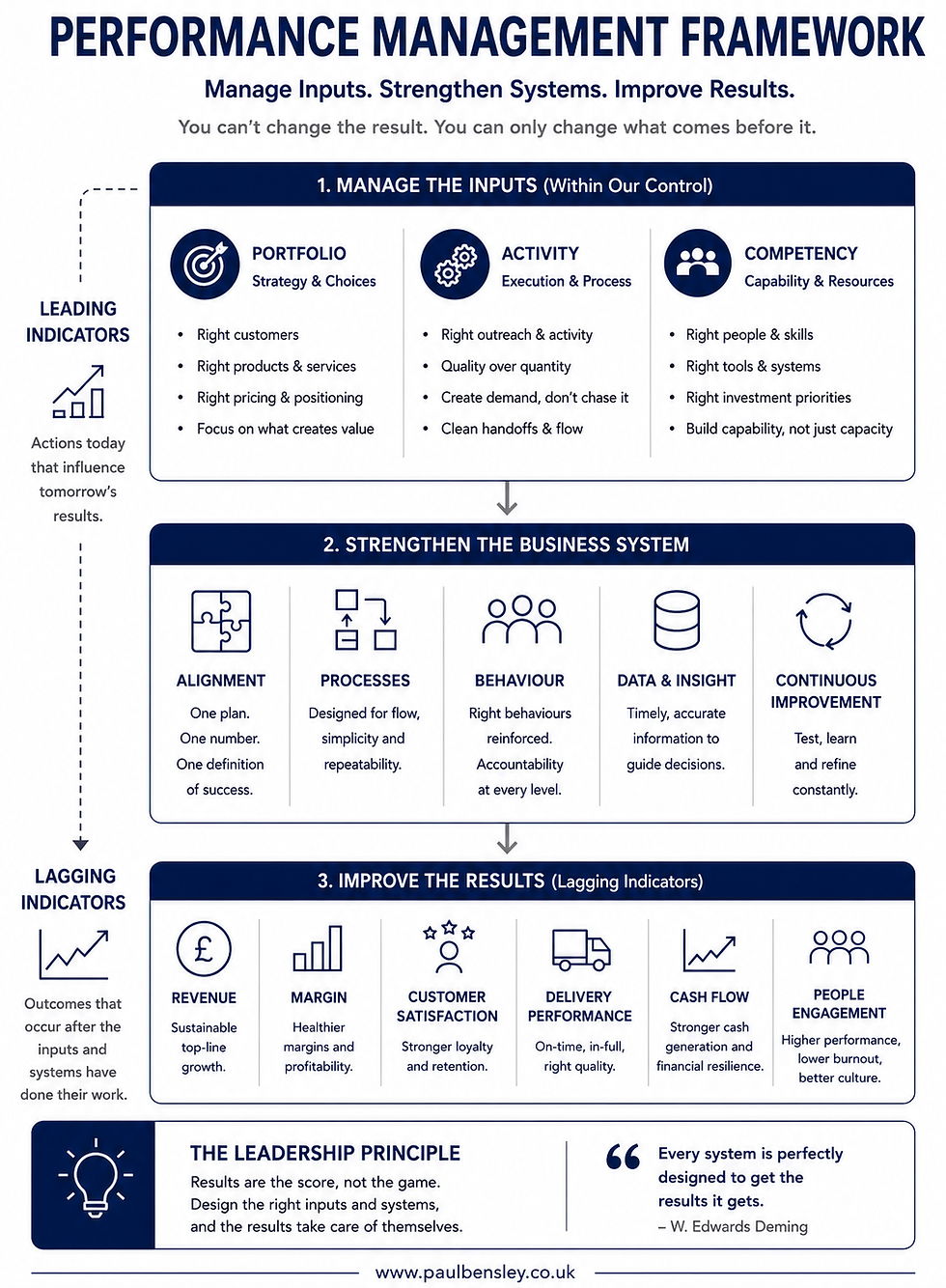
You Can’t Change the Result. You Can Only Change What Comes Before It.
This is one of those truths that sounds obvious - until you realise how often it’s ignored.
As a Leader, I still catch myself looking at results first: Revenue Growth Margins Customer satisfaction Delivery performance
And every time the numbers aren’t where we want them to be, the instinct is the same: What do we do to fix this?
The uncomfortable answer is:
You can’t fix a result. It has already happened.
Results Are Lagging Indicators - Across the Entire Business
Revenue is a lagging indicator. So are:
Customer churn
Pipeline quality
Missed delivery dates
Operational inefficiency
Employee burnout
By the time these show up on a dashboard, the real causes are already embedded in how the business is running.
“The numbers are the score, not the game.” - W. Edwards Deming
If you want different outcomes, you don’t manage the score harder. You redesign the system.
Why Leaders Fall Into the Results Trap - Performance Management
Results are visible. Inputs are not.
Boards ask about revenue. Investors ask about growth. Teams feel pressure when targets are missed.
So we push:
More sales activity
More output
More urgency
But pressure doesn’t fix structural problems. It just exposes them faster.
In my experience, underperformance is rarely a sales problem or an operations problem.
It’s a system alignment problem.
The British Cycling Lesson (Still the Best Example)
When Dave Brailsford took over British Cycling, the gap between winning and losing wasn’t dramatic—it was measured in seconds.
There was no single breakthrough. No heroic intervention.
So he focused on inputs: Training routines Equipment design Recovery processes Environment Standardisation
“If you improve everything by 1%, the combined effect is extraordinary.” — Dave Brailsford
That’s not motivation. That’s leadership through system design.
The Leader’s View: RPAC as a Whole-System Lens
This is the performance management framework I keep coming back to.
Results
Results tell me where to look, not what to fix.
Poor revenue? Low conversion? Missed SLAs? Customer complaints?
Those are symptoms, not causes.
Portfolio
As a Leader, this is where strategy becomes real.
Do we have:
The right customers?
The right products and services?
The right pricing and positioning?
You can have a brilliant sales team and strong operations—and still fail if the portfolio is wrong.
Selling complexity is easy. Delivering it profitably is not.
Activity
This is where sales and operations collide.
Sales:
Are we doing the right outreach?
Are we qualifying properly?
Are we creating demand—or chasing it?
Operations:
Are processes designed for flow?
Are handoffs clean?
Are we scaling work - or just adding friction?
Activity volume means nothing if activity quality is poor.
“Being busy is not the same as being effective.” - Unknown
Competency
This is the hardest conversation - and the most important.
Do we have:
The right people?
The right skills?
The right tools and systems?
The right investment priorities?
You cannot expect consistent performance from a system that underinvests in capability.
No amount of sales pressure fixes weak delivery. No amount of operational excellence fixes a sales team without the right tools or training.
A Personal Reflection
Every time I’ve seen performance sustainably improve, it wasn’t because we demanded more.
It was because we asked better questions:
What are we asking people to do that the system makes unnecessarily hard?
Where are sales promises misaligned with operational reality?
What inputs are actually within our control?
Once we focused there, results improved - not overnight, but predictably.
What This Means for Leadership
If you manage results, you react. If you manage inputs, you lead.
High-performing businesses don’t rely on heroics. They design systems where the right behaviour is the default.
“Every system is perfectly designed to get the results it gets.” - Attributed to Deming
If you found this article useful, you may also enjoy:
FAQs
What is performance management in business?
Performance management is the process of understanding, influencing and improving the factors that determine organisational performance. Effective performance management goes beyond reviewing targets and KPIs. It examines the inputs, behaviours, capabilities and systems that produce those results.
Why is focusing only on results a problem?
Results tell leaders what has already happened. Revenue, margin, customer satisfaction and delivery performance are important, but by the time they appear on a dashboard, the activities that created them have already occurred. Leaders therefore need to use results to identify where to investigate rather than treating the result itself as something they can directly change.
What does “you can't change the result, only what comes before it” mean?
A result is the consequence of earlier decisions, behaviours and processes. If revenue is below target, leaders cannot directly change yesterday's revenue. They can change customer targeting, pricing, sales activity, conversion, capability and other factors that influence future revenue.
What is the difference between leading and lagging indicators?
Lagging indicators measure outcomes that have already occurred, such as revenue, margin or customer churn. Leading indicators measure activities or conditions that influence future outcomes, such as pipeline development, conversion, customer engagement, service performance or employee capability.
Is revenue a lagging indicator?
Yes. Revenue reflects customer decisions and commercial activity that occurred before the number appeared in the financial results. Leaders should therefore use revenue performance as a signal to investigate the commercial drivers responsible for producing it.
Why do leaders focus so heavily on lagging indicators?
Lagging indicators are visible, measurable and usually important to boards and investors. This makes them easy to manage through dashboards and targets. The danger is that organisations become extremely good at measuring outcomes without understanding the system producing them.
Can putting more pressure on targets improve performance?
Sometimes increased focus can improve short-term activity, but pressure alone does not fix structural problems. If employees lack the right proposition, processes, skills, tools or resources, simply demanding more can increase activity without improving the quality of the underlying system.
What should leaders do when a KPI is below target?
Treat the KPI as the starting point for diagnosis rather than the conclusion. Ask what factors influence the result, which of those factors have changed and which are within the organisation's control. The objective is to identify the inputs that need to change to improve future performance.
What is the RPAC performance management framework?
RPAC is a whole-system performance management framework built around four areas: Results, Portfolio, Activity and Competency. Results identify where performance is falling short, while Portfolio, Activity and Competency help leaders investigate what may be producing that outcome.
What does Results mean in the RPAC framework?
Results are the outcomes the organisation is achieving, such as revenue, margin, conversion, service levels or customer performance. They tell leaders where to look, but they do not necessarily explain what needs to be fixed.
What does Portfolio mean in the RPAC framework?
Portfolio examines whether the business has the right customers, products, services, pricing and positioning. Strong execution cannot fully compensate for a weak portfolio. Businesses can be extremely efficient at selling and delivering something customers do not value sufficiently or that cannot be delivered profitably.
What does Activity mean in the RPAC framework?
Activity examines what people and processes are actually doing. In sales this might include prospecting, qualification and demand creation. In operations it can include workflow, handoffs and process efficiency. The objective is to understand both the quantity and quality of activity.
What does Competency mean in the RPAC framework?
Competency examines whether the organisation has the people, skills, tools, systems and investment required to perform effectively. Leaders cannot sustainably demand higher performance from a system that lacks the capability required to deliver it.
How do you use the RPAC framework to diagnose underperformance?
Start with the Result that is below expectation, then work backwards through Portfolio, Activity and Competency. Ask whether the proposition is right, whether the appropriate activities are happening and whether people have the capability and resources required to execute effectively.
Why can increasing activity fail to improve results?
More activity only helps when it is the right activity performed effectively. Increasing sales calls will not necessarily improve revenue if targeting is poor, the proposition is weak or conversion capability is inadequate. Similarly, increasing operational output can create more problems if the underlying process is poorly designed.
Why is being busy not the same as being effective?
Activity measures effort, while effectiveness considers whether that effort contributes to the desired outcome. Organisations can generate enormous amounts of activity that add little customer or financial value. Leaders should therefore understand which activities actually drive performance.
How can leaders identify the root cause of underperformance?
Begin with the performance gap and repeatedly work backwards through the factors that could have created it. Examine portfolio, customer behaviour, activity, processes, capability and resources rather than immediately assuming that the most visible department owns the problem.
Why is underperformance often a system problem?
Business results are usually produced by interactions between multiple functions. Sales performance can depend on product, pricing, service and operational capability, while operational performance can depend on demand quality and sales promises. What appears to be a departmental problem can therefore be a misalignment between different parts of the business system.
How does portfolio complexity affect business performance?
Additional products, services and customer requirements can create revenue while simultaneously increasing operational complexity and cost. Leaders therefore need to consider whether the portfolio can be sold, delivered and supported profitably, rather than assuming that more choice automatically creates better performance.
How can sales and operations alignment improve performance?
Sales and operations need shared understanding of what customers are being promised, what the business can reliably deliver and which activities create profitable value. Misalignment can produce poor handoffs, service problems, excess complexity and internal conflict even when both departments are individually working hard.
Why is competency important in performance management?
Processes and targets cannot compensate indefinitely for insufficient capability. If people lack the required skills, training, tools, systems or resources, performance problems are likely to persist regardless of how frequently leaders review the numbers.
What is systems thinking in performance management?
Systems thinking recognises that business outcomes emerge from interconnected processes, decisions, behaviours and capabilities. Instead of blaming an individual function for a poor result, leaders examine how the wider system is producing that outcome.
What questions should leaders ask when performance is below target?
Useful questions include: What result is actually underperforming? What changed? Is the portfolio right? Are we doing the right activities? Are those activities being executed effectively? Do people have the capability and tools required? And what part of the system is making good performance unnecessarily difficult?
What is the biggest mistake leaders make when managing performance?
One of the biggest mistakes is trying to manage the result rather than the things that create it. Repeatedly demanding more revenue, margin or output does not explain how those improvements will happen. Leaders need to identify and change the inputs capable of producing a different future result.
How can businesses create sustainable performance improvement?
Sustainable improvement comes from changing the underlying system rather than relying on repeated interventions or individual heroics. Leaders should identify the performance gap, diagnose its drivers and improve the portfolio, activity and competency required to produce better results consistently.


Comments