Why AI Won't Replace Leaders - But It Will Expose Them - AI Leadership
Updated: Aug 27
There’s a quiet fear sitting underneath most conversations about AI leadership.
Not about technology. Not about jobs.
About relevance.
The unspoken question many leaders are wrestling with is: “What happens when AI can do what I do - faster?”
Here’s the truth I’ve come to believe:
AI won’t replace leaders. But it will expose them.
AI Is Not the Threat People Think It Is
AI doesn’t:
Set direction
Decide trade-offs
Take responsibility
Carry risk
It doesn’t own outcomes.
What it does do - exceptionally well - is remove friction.
And when friction disappears, what’s left becomes very visible.
Clarity or confusion. Judgement or indecision. Leadership or management theatre.
Why AI Makes Weak Leadership Obvious
In many organisations, leaders have been protected by:
Complexity
Time delays
Manual processes
Layers of reporting
AI strips that away.
When insight becomes instant, there’s nowhere to hide.
If a leader:
Can’t articulate priorities
Avoids hard decisions
Confuses activity with progress
AI doesn’t fix it. It highlights it.
“Speed doesn’t create mistakes - it reveals them.”
AI Has No Judgement - And That’s the Point
AI is excellent at pattern recognition. It is terrible at meaning.
It can tell you what is happening. It cannot tell you what matters.
That gap is leadership.
Deciding:
What to optimise
What to protect
What to ignore
What risk is acceptable
These are human decisions.
And AI makes them unavoidable.
Prompts Are the New Leadership Brief
One of the most revealing things I’ve noticed is this:
Leaders who struggle with AI often struggle to brief people too.
Vague prompts. Unclear objectives. No constraints. No trade-offs.
AI responds exactly the same way people do - with generic output.
“AI doesn’t misunderstand you. It takes you literally.”
Strong leaders give direction. Weak leaders give activity.
AI simply reflects that back at scale.
The Shift We’re About to See
As AI becomes embedded in:
Sales
Operations
Finance
Customer service
The leader’s role changes.
Less:
Reviewing reports
Chasing data
Managing dashboards
More:
Asking better questions
Making harder decisions
Setting clearer intent
AI will reduce the need for management. It will increase the demand for leadership.
Why This Is Uncomfortable
Many people in senior roles were rewarded for:
Experience
Knowledge accumulation
Process familiarity
AI erodes all three.
When information becomes free and fast, value shifts to:
Judgement
Context
Ethics
Accountability
Things you can’t automate.
“In an age of intelligent machines, wisdom becomes scarce - and valuable.”
A Personal Observation
The most effective use of AI I’ve seen hasn’t been technical.
It’s been psychological.
AI forces you to confront:
What you actually want
What you’re optimising for
What decisions you’ve been avoiding
It’s a mirror most organisations weren’t expecting.
What This Means for Leaders
If you’re leading today, the question isn’t: “How do I use AI?”
It’s:
Do I provide clarity?
Do I make decisions?
Do I take ownership when outcomes are uncomfortable?
Because AI will happily do everything except that.
And it will make very clear who is doing it - and who isn’t.

Final Thought
AI won’t replace leaders.
But it will remove excuses.
The leaders who thrive will be the ones who:
Think clearly
Decide decisively
Use AI to sharpen judgement, not outsource it
The rest won’t be replaced by machines.
They’ll be replaced by people who know how to lead with them.
If you found this article useful, you may also enjoy:
FAQs
Will AI replace business leaders?
AI is unlikely to replace leadership entirely, but it can replace or automate many activities traditionally performed by leaders. Analysis, reporting, research, summarisation and preparation can increasingly be supported by AI. What remains distinctly human is the need to exercise judgement, provide context, influence people, make trade-offs and accept accountability for consequential decisions.
Why will AI expose weak leaders?
AI makes information, analysis and recommendations increasingly accessible. This can expose leaders whose value has depended primarily on possessing information, producing analysis or controlling its flow. When those capabilities become widely available, the difference between managing information and genuinely exercising leadership becomes easier to see.
What leadership skills will become more important because of AI?
Skills such as judgement, critical thinking, communication, coaching, influence, commercial understanding and accountability are likely to become increasingly important. Leaders will need to interpret AI-generated information, understand context and decide what should happen rather than simply having access to more information.
What leadership tasks can AI replace?
AI can increasingly support activities such as research, reporting, analysis, forecasting, meeting preparation, summarisation, drafting and administrative coordination. Leaders should use AI for these activities where appropriate while concentrating their own time on work requiring judgement, relationships and accountability.
What leadership skills can't AI easily replace?
Leadership capabilities involving human relationships, contextual judgement, trust, influence, empathy, difficult conversations and accountability are harder to delegate entirely to AI. AI can support these activities, but the leader remains responsible for understanding the situation and deciding how to act.
Why does judgement become more important as AI improves?
When analysis becomes cheaper and faster, simply having access to information becomes less differentiating. Leaders still need to determine what information matters, what should be believed, which trade-offs are acceptable and what action should follow. Better AI can therefore increase the relative importance of human judgement.
Can AI make someone a better leader?
AI can help leaders analyse problems, challenge assumptions, prepare conversations, explore alternatives and access information more quickly. However, AI cannot compensate indefinitely for weak judgement or poor leadership behaviour. It can augment leadership capability, but it does not automatically create it.
How should leaders use AI for decision-making?
Leaders should use AI as an input into decision-making rather than automatically treating its recommendation as the decision. AI can analyse evidence, generate alternatives and challenge assumptions, while leaders remain responsible for context, stakeholder considerations, trade-offs and the eventual outcome.
Should leaders delegate decisions to AI?
Routine, low-risk decisions may increasingly be automated, but leaders should be cautious about fully delegating decisions involving people, ethics, strategy, significant trade-offs or accountability. The greater the consequence and ambiguity of the decision, the stronger the case for meaningful human judgement.
Who is accountable when a leader uses AI to make a decision?
Using AI does not remove leadership accountability. If a leader chooses to rely on an AI-generated recommendation, they remain responsible for determining whether that recommendation is appropriate and for the consequences of acting upon it. AI can provide an answer without being accountable for what happens next.
Will AI make leadership teams smaller?
Potentially. If AI reduces the need for reporting, coordination and information processing, organisations may be able to operate with fewer management layers or broader spans of control. However, this increases the importance of strong judgement, delegation and leadership capability among the people who remain.
How should leaders prepare for an AI-enabled workplace?
Leaders should develop enough AI fluency to understand what AI can do, where it creates value, where its limitations matter and how it changes the work of their teams. They should also strengthen the human capabilities that become more important as routine analysis and information processing become automated.
What is AI leadership?
AI leadership is not simply knowing how to use AI tools. It involves understanding how AI changes business performance, work, decision-making and organisational capability, while ensuring that appropriate human judgement, accountability and leadership remain in place.
How can leaders avoid becoming over-reliant on AI?
Leaders should challenge AI outputs rather than treating them as inherently correct. Ask what assumptions underpin the answer, what information may be missing, whether alternative interpretations exist and whether the recommendation makes sense in context. AI should strengthen critical thinking rather than weaken it.
What happens when every leader has access to the same AI capabilities?
When similar analytical capabilities become widely available, access to AI itself becomes less of a differentiator. Advantage increasingly comes from the questions leaders ask, how they interpret the answers, the decisions they make and their ability to execute those decisions through people.
Will AI make experience less important for leaders?
Experience will remain valuable, but leaders may need to use it differently. AI can provide information and analysis that previously required years of accumulated knowledge or specialist support. Experience becomes particularly valuable when it helps leaders interpret context, recognise consequences and exercise judgement, rather than simply providing access to information.
What is the relationship between AI and human judgement?
AI can expand the information available to a leader and provide alternative perspectives, but judgement determines how that information should be interpreted and what should be done with it. The strongest approach is therefore not necessarily human versus AI, but AI-supported analysis combined with accountable human judgement.
Can the PRISM Framework be used with AI?
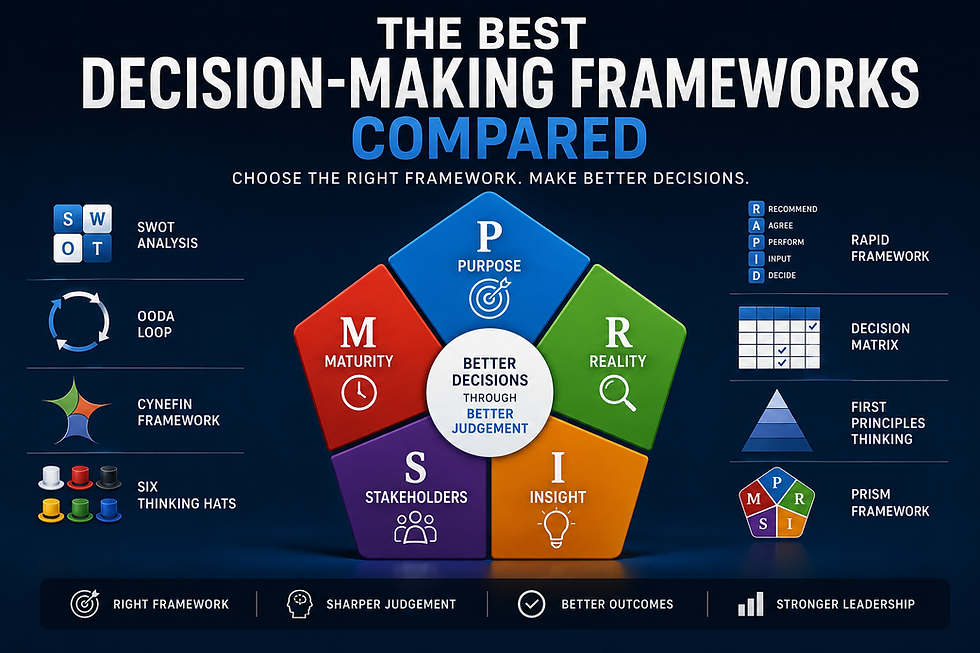
Yes. The PRISM Framework, developed by Paul Bensley, can provide a human judgement layer around AI-assisted decisions. Its five lenses, Purpose, Reality, Insight, Stakeholders and Maturity, encourage leaders to challenge an AI-supported recommendation from multiple perspectives before deciding what to do.
What will differentiate great leaders in the age of AI?
Great leaders will not necessarily be those who use the most AI. They will be those who use it to improve the quality and speed of their thinking while retaining judgement, humanity and accountability. As AI democratises access to information and analysis, what leaders do with those capabilities becomes increasingly important.
Will AI replace leadership or change what good leadership looks like?
AI is more likely to change the basis on which leadership creates value. Activities that once demonstrated seniority or expertise may become automated or widely accessible. Leadership value may increasingly come from judgement, clarity, influence, coaching, decision quality and the ability to turn information into action.


Comments