Most People Don't Know How to Talk to AI (And Why It Matters) Business AI Prompts
- Paul Bensley
- Jul 1
- 6 min read
Updated: Aug 27
After Data, Prompts Are the Most Important Thing in AI
It took me longer than it should have to realise this.
When most people talk about AI, the conversation quickly drifts toward tools, models, or data. And while data is critical, there’s something that sits immediately behind it in importance:
The prompt. Specifically Business Ai Prompts.
Not as a technical input - but as a reflection of how clearly you think.
Why Prompts Matter More Than People Realise
AI doesn’t think. It doesn’t reason in the human sense. It responds.
And what it responds to is direction.
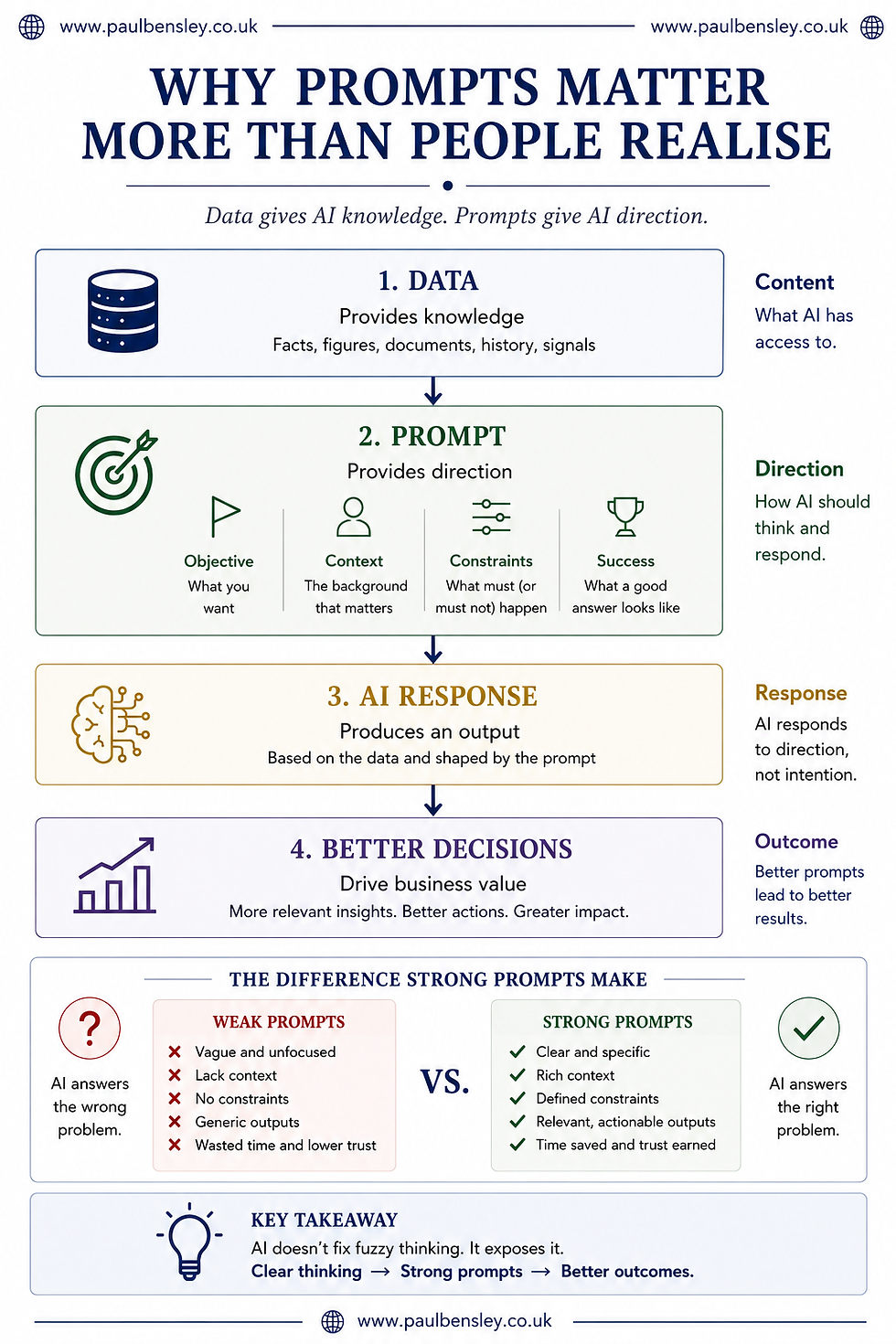
A prompt is not a question. It’s a brief.
It tells the AI:
What you care about
What you’re trying to achieve
What success looks like
What constraints matter
Poor prompts don’t produce “bad AI”. They produce perfectly accurate answers to the wrong problem.
“AI is only as good as the questions you ask.” - A cliché, but an accurate one
The Parallel Most People Miss
I’ve noticed something interesting.
The same people who struggle to get value from AI are often the same people who struggle to:
Write clear briefs
Define problems properly
Explain what they actually want
AI is brutally honest in this way.
It doesn’t fix fuzzy thinking. It exposes it.
Why Prompts Come Second Only to Data
Data gives AI content. Prompts give it context.
Without context:
AI guesses
Outputs feel generic
Insights lack relevance
Trust erodes quickly
With strong prompts:
Outputs sharpen
Patterns emerge
Insight becomes usable
Time is genuinely saved
This is why two people using the same AI tool can have wildly different results.
The difference isn’t the software. If you want to Get Real Value From AI (Without Being Technical) have a look at The Prompt Framework Cheat Sheet.
If you found this article useful, you may also enjoy:
FAQs
Why do people struggle to get good results from AI?
People often give AI too little context, unclear objectives or vague instructions, then expect a highly relevant answer. AI can only work with the information and direction it has been given. Better results usually begin with explaining the problem clearly and providing the context that materially affects the answer.
How should you talk to AI?
Talk to AI as though you are briefing a capable colleague who does not automatically know your situation. Explain what you are trying to achieve, provide relevant context, identify important constraints and describe what a useful outcome looks like. You can then refine the response through further conversation.
Why does context matter when prompting AI?
Context helps AI understand the circumstances surrounding the request. A business recommendation can change significantly depending on the organisation, customer, market, objective, resources and constraints involved. Without that information, AI may provide an answer that is technically reasonable but too generic to be useful.
What makes a good business AI prompt?
A good business AI prompt clearly communicates the problem, relevant context, desired outcome and important constraints. It should give AI enough information to understand what a useful response looks like without overwhelming it with irrelevant detail.
Why does AI sometimes give generic answers?
AI often gives generic answers when the question itself is generic. Asking “How can I grow my business?” provides very little information about the organisation or problem. Explaining the business model, customers, current performance, objective and constraints gives AI a much stronger basis for providing a useful response.
Do you need to learn prompt engineering to use AI effectively?
Most businesspeople do not need to become prompt engineers. They need to become better at defining problems, communicating context, asking useful questions and evaluating answers. These are fundamentally business and communication skills rather than purely technical capabilities.
Is talking to AI different from using a search engine?
Yes. A search engine primarily helps you find existing information, while conversational AI can analyse, combine, challenge and develop information through an ongoing dialogue. Treating AI purely like search can therefore limit its usefulness.
Should you write long prompts for AI?
Not necessarily. A longer prompt is not automatically better. The objective is to provide relevant information rather than maximum information. A short prompt containing the right context can produce a better result than a very long prompt filled with unnecessary instructions.
Is it better to have a conversation with AI than use one perfect prompt?
For complex business problems, often yes. You can begin by explaining the situation, allow AI to identify missing information, answer its questions and progressively refine the analysis. The quality of the conversation can matter more than the sophistication of the first prompt.
Can I ask AI to question me before answering?
Yes. For complex problems, asking AI to identify what it needs to know and ask questions before recommending a solution can produce significantly better results. This reduces the likelihood that the AI fills gaps in the situation with assumptions.
How can I stop AI from agreeing with everything I say?
Ask AI to actively challenge your thinking. For example, ask it to identify weak assumptions, missing evidence, alternative explanations, risks and reasons your preferred solution might be wrong. This can make AI more useful as a thinking partner rather than simply a tool for validating an existing opinion.
Why should business leaders learn how to communicate with AI?
AI is increasingly becoming a tool for analysis, problem-solving, communication and decision support. Leaders who can clearly define a problem and provide appropriate context are more likely to extract useful insight from these systems. Poor communication with AI can result in poor outputs regardless of how capable the underlying technology becomes.
Can better AI prompts improve business decision-making?
Yes, because better prompts can produce more relevant analysis, alternative perspectives and stronger challenges to assumptions. However, improved AI output does not automatically mean a better decision. Leaders still need to evaluate the information, understand context and exercise judgement.
What are the most common mistakes people make when talking to AI?
Common mistakes include asking vague questions, withholding important context, expecting AI to know information it has never been given, accepting the first response and failing to challenge assumptions. Another mistake is treating prompting as a one-way instruction rather than an iterative conversation.
Should AI be given examples of what you want?
Examples can be extremely useful when the required output has a particular format, tone or level of detail. They give AI another source of context about what success looks like. However, examples should guide the output rather than unnecessarily constrain useful alternatives.
Can AI help improve a bad prompt?
Yes. You can explain what you are trying to achieve and ask AI what additional information it needs before answering. You can also ask it to identify ambiguity or weaknesses in your request. In this way, AI can help improve the conversation itself rather than simply respond to the initial instruction.
What is the Business AI Prompt Framework?
The Business AI Prompt Framework, developed by Paul Bensley, is a practical approach designed to help business users structure better interactions with AI. It focuses on providing the context, objective and direction AI needs to produce outputs that are more relevant to real business problems.
Is prompting AI really a leadership skill?
Increasingly, yes. Effective AI use requires leaders to define problems clearly, communicate context, ask good questions, challenge assumptions and exercise judgement over the answer. Those capabilities were valuable leadership skills before generative AI existed and become even more useful when working with it.
Does a better prompt guarantee an accurate AI answer?
No. Better prompting can improve relevance and reduce misunderstanding, but AI can still make mistakes, misunderstand information or produce inaccurate conclusions. Important outputs should therefore be critically evaluated and, where necessary, independently verified.
What is the most important rule for getting better results from AI?
Do not expect AI to understand context you have never provided. Explain what you are trying to achieve, what the AI needs to know and what a useful outcome looks like, then treat the interaction as a conversation rather than expecting one perfect answer immediately.

Comments