A Practical AI Business Implementation Checklist (No Hype, No Consultants Required)
- Paul Bensley
- Jul 1
- 6 min read
Updated: Aug 27
if you’re serious about AI, this is where to start - before spending a pound externally.
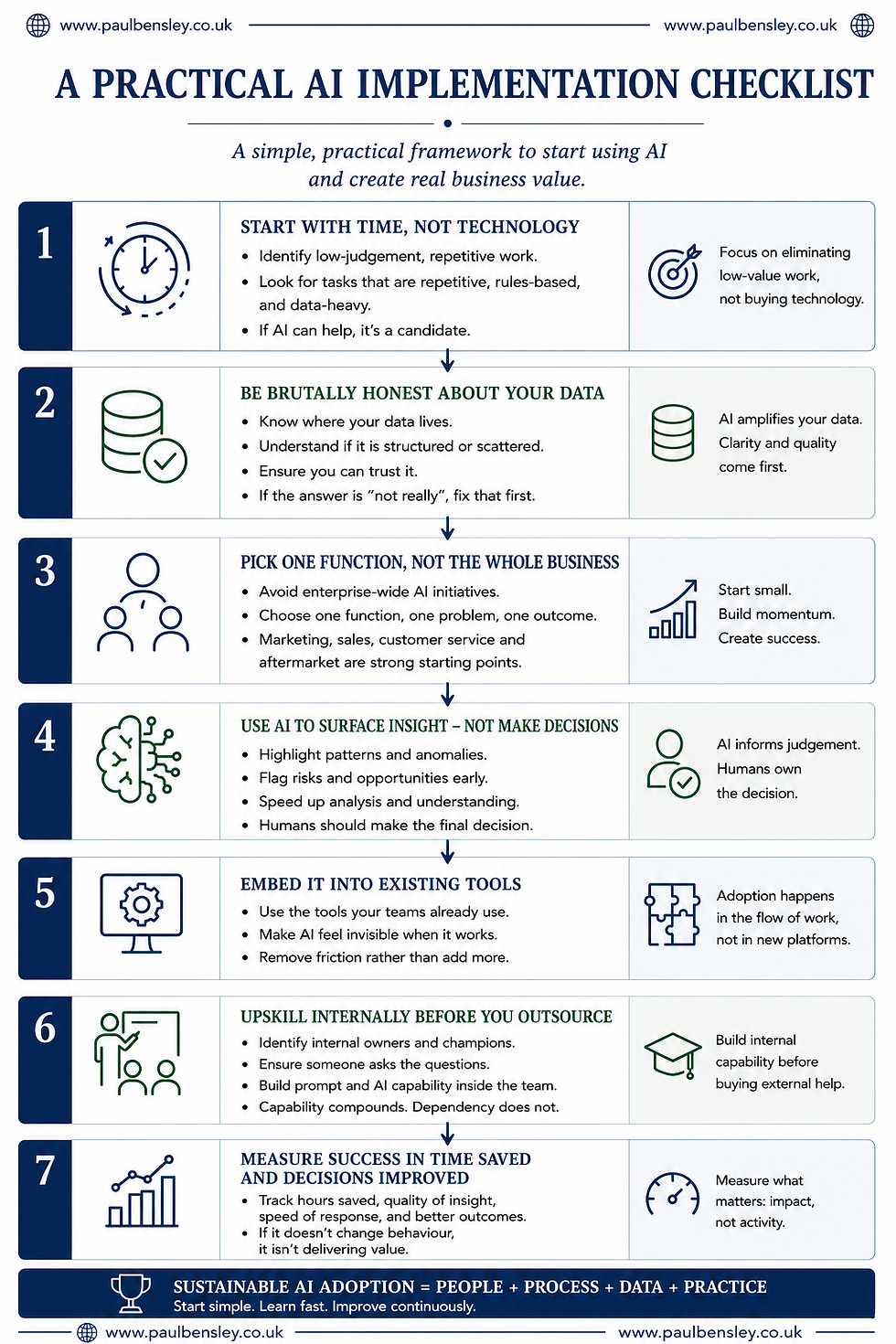
AI business implementation checklist.
1. Start With Time, Not Technology
Ask one simple question: Where are humans spending time on low-judgement work?
Examples:
Creating repetitive content
Pulling data from multiple systems
Answering the same customer questions
Preparing reports no one enjoys writing
If a task is:
Repetitive
Rules-based
Data-heavy
AI can probably help.
2. Be Brutally Honest About Your Data
AI doesn’t fix bad data - it amplifies it.
Before doing anything clever, ask:
Do we know where our data lives?
Is it structured or scattered?
Do we trust it?
If the answer is “not really”, fix that first. AI rewards clarity, not ambition.
“AI is only as smart as the questions you ask - and the data you give it.”
3. Pick One Function, Not the Whole Business
The fastest failures come from “enterprise-wide AI initiatives”.
Instead:
Pick one function
Pick one problem
Pick one outcome
Marketing, sales, customer service, or aftermarket are ideal starting points.
Momentum beats perfection.
4. Use AI to Surface Insight - Not Make Decisions
The goal isn’t automation for its own sake.
Use AI to:
Highlight patterns
Flag risks early
Suggest opportunities
Reduce analysis time
Humans should still make the call.
“AI should inform judgement, not replace it.”
5. Embed It Into Existing Tools
If people have to log into “another platform”, adoption will fail.
The best AI implementations:
Sit inside tools teams already use
Feel invisible when they work
Remove friction rather than add it
Adoption is a design problem, not a training one.
6. Upskill Internally Before You Outsource
Before hiring an agency, ask:
Who internally will own this?
Who will ask the questions?
Who will improve the prompts?
AI capability compounds. Dependency does not.
Start small. Learn fast. Build confidence.
7. Measure Success in Time Saved and Decisions Improved
Forget vanity metrics.
Measure:
Hours saved
Quality of insight
Speed of response
Better conversations
If AI doesn’t change behaviour, it isn’t delivering value.
Read my article that lays the foundations for this checklist.
If you found this article useful, you may also enjoy:
FAQs
How do you implement AI in a business?
Start with a business problem rather than an AI tool. Identify processes where AI could improve productivity, customer experience, decision-making, revenue, margin or cost. Select a small number of use cases, establish appropriate controls, test them with employees and measure whether they produce a meaningful improvement before scaling.
Where should a business start with AI?
Start by examining how work currently gets done. Look for repetitive tasks, information bottlenecks, manual analysis, customer friction and activities consuming significant employee time. The best starting point is often a clearly defined business problem where AI can be tested relatively quickly and safely.
Does a business need an AI strategy before using AI?
Businesses need direction, but they do not necessarily need a lengthy AI strategy before beginning. Leaders should understand why they want to use AI, which business priorities it should support and what boundaries employees need to operate within. Practical experimentation can then inform a broader strategy.
Does a small or medium-sized business need an AI consultant?
Not necessarily. Many businesses can begin by identifying simple use cases, using approved mainstream AI tools and learning through controlled experimentation. External expertise can be useful for complex technology, integration, security or transformation requirements, but businesses should first understand what problem they are actually trying to solve.
What should be included in an AI implementation checklist?
A practical checklist should cover business objectives, potential use cases, expected outcomes, data and security requirements, approved tools, ownership, employee training, testing, measurement and scaling. It should also identify where human review or judgement must remain part of the process.
How do you identify good AI use cases?
Look for activities that are repetitive, time-consuming, information-heavy or difficult to scale, then determine whether improving them would create a meaningful business benefit. A good use case combines technical feasibility with a clear operational or commercial outcome.
How should businesses prioritise AI use cases?
Prioritise use cases according to potential value, ease of implementation, risk and ability to measure the result. A relatively simple application with a clear business benefit can be a better starting point than an ambitious AI project requiring significant investment and organisational change.
Should businesses start with an AI pilot?
Usually, yes. A focused pilot allows the organisation to test assumptions, understand employee behaviour and measure results before committing significant resources. The pilot should have a specific objective, defined owner and clear success measures rather than simply encouraging people to experiment with AI.
How much does it cost to implement AI in a business?
AI implementation does not necessarily require a large initial investment. Some use cases can begin with existing software or relatively inexpensive AI subscriptions, while complex automation and system integration can require substantial investment. Leaders should match the level of investment to the value of the problem being solved.
What AI policies should a business have?
Businesses should provide clear guidance around approved tools, confidential information, personal data, intellectual property, verification of outputs and decisions requiring human oversight. The policy should protect the organisation without becoming so restrictive that useful experimentation becomes impossible.
What information should employees not put into AI tools?
Employees should avoid entering confidential, personal, commercially sensitive or restricted information into AI systems unless the organisation has specifically approved the tool and its use for that information. Clear organisational guidance is preferable to expecting every employee to make their own judgement about data security.
How much AI training do employees need?
Most employees need practical rather than highly technical training. They should understand what AI can and cannot do, how to communicate with it effectively, how to check its outputs, what information they can use and where human judgement remains necessary.
Who should be responsible for AI implementation?
AI implementation should not sit entirely with IT. Technology teams may own areas such as security and systems, but business leaders should own the problem, expected outcome and changes to how work gets done. Successful implementation usually requires cooperation between technology, functional leaders and the employees doing the work.
How should leaders involve employees in AI implementation?
Employees often understand workflow problems better than senior leadership because they encounter them every day. Leaders should ask teams where time is being wasted, which activities are repetitive and what prevents them from performing effectively, then involve them in testing and improving relevant AI use cases.
How do you measure whether an AI implementation is successful?
Measure the outcome the AI was intended to improve. This might include time saved, additional capacity, response speed, conversion, customer satisfaction, revenue, margin or cost. Usage can be useful information, but the number of employees using AI is not by itself evidence of business value.
Does saving employee time with AI automatically save money?
No. Saving time creates capacity, not necessarily financial value. Leaders need to decide what happens to that capacity. It may allow employees to produce more, improve customer service, generate additional revenue, reduce overtime or avoid future recruitment. Without that conversion, productivity improvements may never reach financial performance.
When should an AI pilot be scaled across the business?
Scale when the use case produces a repeatable improvement, employees can use it effectively, risks are understood and there is a credible business case for wider adoption. A technically successful pilot should not automatically be scaled if the underlying business value remains unclear.
What are the biggest mistakes businesses make when implementing AI?
Common mistakes include starting with technology rather than a problem, launching too many use cases, providing insufficient employee guidance, ignoring data risks, measuring adoption instead of outcomes and scaling experiments before proving their value.
How can businesses implement AI without creating chaos?
Create enough governance to establish boundaries while allowing employees to experiment within them. Define approved tools, responsibilities, data rules and areas requiring human oversight, then create a process for identifying, testing and sharing successful use cases. The objective is governed experimentation rather than uncontrolled adoption.
How do you turn AI implementation into financial value?
Trace the improvement from the AI use case through to a measurable business outcome. For example:
AI use → time saved → additional capacity → increased sales activity → additional gross profit → EBITDA improvement.
This prevents organisations from assuming that an operational improvement automatically becomes financial value.
What is the AI-to-EBITDA Framework?
The AI-to-EBITDA Framework, developed by Paul Bensley, connects AI initiatives to financial performance through five stages: AI Use Case → Operational Impact → Business Driver → Financial Conversion → EBITDA Impact. It helps leaders identify whether improvements created by AI are actually being converted into measurable business value.
Can a business implement AI without a large transformation programme?
Yes. Businesses can start with a small number of well-defined problems, establish sensible governance, test practical use cases and expand what works. AI implementation does not always need to begin as a major transformation programme. Small, measurable improvements can provide the evidence needed to justify larger investments later.

Comments