AI Won’t Fix Your Business. But It Will Expose It. AI in Business
Updated: Aug 27
Why Most Companies Are Struggling to Use AI (And How to Actually Get Value From It)
AI is the latest word that does a strange thing to leaders.
It creates excitement, anxiety, fear, hope - sometimes all at once.
Some dismiss it entirely. Some rush to adopt it just so they can say they have.
Very few are actually using it to improve how their business performs.
And that’s the problem.
The AI in Business Gold Rush (And the Mistake Most Companies Are Making)
At the very least, the noise around AI has done one good thing: It’s forced people to think about the art of the possible.
Unfortunately, many organisations are now trying to use AI to solve problems that could - and should - have been solved years ago with basic digital tools.
Load building. Transport optimisation. Sales reporting. Process mapping.
These are not AI problems. They’re discipline and data problems.
Most of them are mathematical challenges that computers have been perfectly capable of solving for decades - if they’re given the right parameters and asked the right questions.
The uncomfortable truth is this:
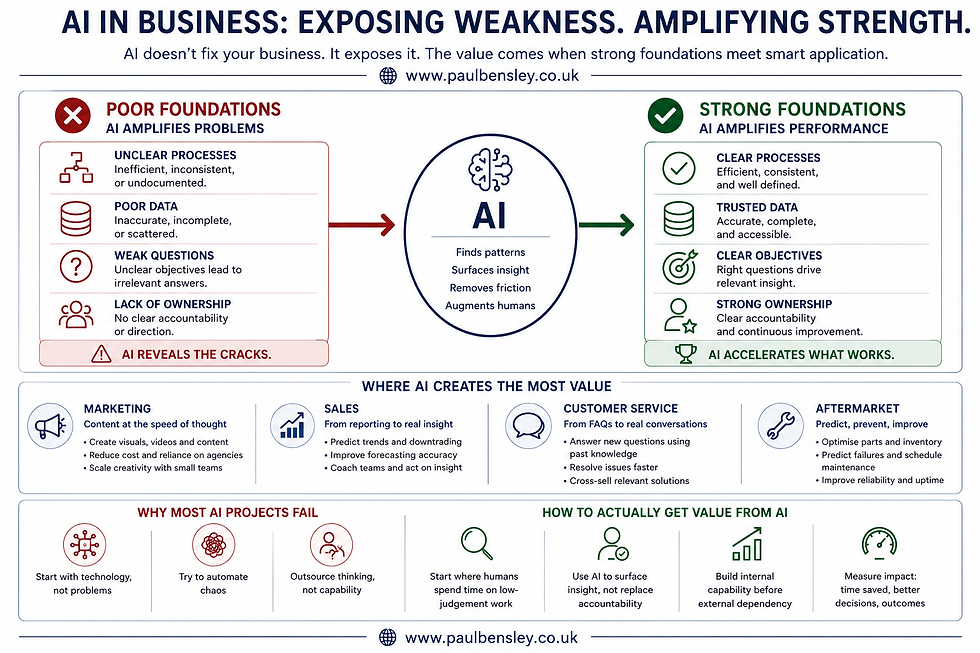
AI isn’t exposing a lack of technology - it’s exposing a lack of clarity.
Where AI Actually Works Best: Augmenting Humans
AI delivers the most value when it augments human capability, not when it’s asked to replace thinking altogether.
Used properly, it allows:
Small teams to behave like much larger ones
Leaders to spend time on judgement instead of spreadsheets
Managers to act on insight instead of chasing data
Or as Andrew Ng puts it:
“AI is the new electricity.”
Electricity didn’t replace factories - it made them exponentially more productive.
AI is no different.
Four Practical Places to Start (Without Spending a Fortune)
1. Marketing: Content at the Speed of Thought
Marketing is one of the easiest and lowest-risk places to start.
Tools like OpenArt AI and similar platforms allow teams to create:
Product imagery
Campaign visuals
Short videos and animations
Instructional content
No more trawling stock image sites. No more expensive licences for generic visuals. No need to brief an agency for every simple asset.
This is a huge shift.
For smaller businesses, it means doing more with limited headcount. For larger ones, it means dramatically increasing output without increasing cost.
“Creativity scales when friction disappears.” - Unknown
The power is no longer outsourced - it’s internal.
2. Sales: From Reporting to Real Insight
At its core, sales is simple: Making money by satisfying customers.
We’ve just made it unnecessarily complex.
Most sales teams already use data - but usually at surface level:
Revenue
Margin
Number of calls
Tools like Copilot can already analyse customer data to highlight:
Product gaps
Geographic black spots
Margin inconsistencies
But used properly, AI can go much further.
With the right direction, it can:
Predict trends before they show up in revenue
Identify customer downtrading early
Improve forecasting accuracy
Surface risks invisible to the naked eye
Even more powerful is triangulating behavioural data:
Email activity
Call duration and frequency
Travel patterns
Performance outcomes
Suddenly, a sales manager can see:
Salespeople who spend X time with Y type of customer, at Z frequency, consistently outperform on margin.
The manager’s role then changes.
Less time analysing. More time coaching and acting.
Which, if we’re honest, is where most managers add the most value anyway.
3. Customer Service: From FAQs to Real Conversations
Most “AI chatbots” today are terrible.
They answer basic FAQs and frustrate customers.
But that’s not a technology limitation - it’s a data one.
When you feed tools like ChatGPT with:
Historical support data
Product documentation
Common resolution paths
You can create bots that:
Answer new questions using past knowledge
Resolve issues faster
Reduce pressure on human teams
Go one step further and integrate sales data, and now your chatbot can:
Recommend relevant add-ons
Cross-sell genuinely helpful products
Improve conversion on your website
This isn’t about removing humans. It’s about letting humans deal with the problems that actually need them.
4. Aftermarket: Predict, Prevent, Improve
Aftermarket is where AI quietly becomes transformational.
By analysing:
Service histories
Warranty claims
Online reviews
Failure patterns
AI can help:
Optimise spare parts inventory
Predict which components fail most often
Schedule preventative maintenance
Reduce downtime
Feed insights back into product design
Instead of reacting to problems, you start anticipating them.
“The best service event is the one that never happens.”
This is where AI stops being interesting - and starts being valuable.
Why Most AI Projects Fail
From what I’ve seen, AI initiatives fail for three reasons:
They start with technology instead of problems
They try to automate chaos
They outsource thinking instead of capability
Throwing money at consultants won’t fix broken data, unclear processes, or weak questions.
AI doesn’t need perfection. But it does need intent.
How to Actually Get Started
If you’re thinking about AI, my advice is simple:
Start where humans spend time but add limited judgement
Use AI to surface insight, not replace accountability
Build internal capability before external dependency
You don’t need a six-figure programme. You need clarity, direction, and the courage to experiment sensibly.
The companies winning with AI aren’t shouting about it. They’re quietly redesigning how work gets done.
Final Thought
AI isn’t magic. It’s leverage.
And like any leverage, its value depends entirely on where you apply it.
If you’re thinking seriously about how AI could actually improve performance - not just tick a box - it’s a conversation worth having.
Not about tools. But about outcomes.
And that’s where most organisations need the most help.
If you found this article useful, you may also enjoy:
FAQs
Can AI fix an underperforming business?
AI can help improve specific activities, but it cannot automatically fix an underperforming business. If the underlying problem is poor strategy, weak processes, unclear accountability, bad data or ineffective management, adding AI may simply make those weaknesses more visible. Leaders need to understand the business problem before deciding whether AI is part of the solution.
Why can AI expose problems in a business?
AI can make work faster and information easier to access, which removes some of the friction that previously disguised organisational problems. When reporting becomes faster, for example, leaders may discover that the real bottleneck was never producing information but making decisions and acting upon it.
What does “AI won't fix your business, but it will expose it” mean?
It means AI often reveals weaknesses that already exist rather than creating them. Poor processes can become faster poor processes, weak decisions can be made more quickly and unclear accountability remains unclear even when better information is available. AI can therefore act as a powerful amplifier of both organisational strengths and weaknesses.
Should businesses fix their processes before implementing AI?
Businesses do not need every process to be perfect before using AI, but they should understand how the process currently works and what problem they are trying to solve. Automating a poorly designed process can simply make inefficiency happen faster. AI implementation is often an opportunity to redesign the work rather than automate it exactly as it exists.
Can AI make a bad process worse?
Yes. If a process contains unnecessary steps, poor data, unclear decisions or inappropriate controls, AI can potentially increase the speed and scale at which those problems occur. Leaders should therefore ask whether the process should be improved, simplified or eliminated before deciding how much of it should be automated.
Why should businesses start with the problem rather than the AI tool?
Starting with the problem forces leaders to define what actually needs to improve. Starting with the technology can lead organisations to search for somewhere to use AI simply because they have access to it. A better question is “What business problem are we trying to solve?” followed by whether AI is an appropriate way to solve it.
What business problems can AI help solve?
AI can help with problems involving repetitive work, information processing, analysis, forecasting, customer interactions, content creation and decision support. The value depends on whether improving those activities produces a meaningful operational or commercial outcome.
Can AI improve productivity without improving business performance?
Yes. AI can make employees significantly faster without necessarily improving the company's financial results. Time saved creates capacity, but leaders still need to decide how that capacity will be converted into greater output, better customer service, additional revenue, reduced cost or avoided expenditure.
Why doesn't saving time with AI automatically save money?
If an employee saves five hours each week but continues producing the same output at the same cost, the business has created capacity but may not have created a financial benefit. The value depends on what the organisation does with the released time.
Can AI solve poor management?
AI can provide managers with better information, analysis and tools, but it cannot automatically create clear expectations, accountability, good judgement, coaching or effective leadership. In some cases, AI may actually make weak management more visible because administrative activity can no longer be confused as easily with managerial value.
Can AI fix a bad business strategy?
AI can help leaders analyse markets, test assumptions and explore alternatives, but it cannot make a fundamentally weak strategy successful simply through better execution. Leaders still need to determine where to compete, how to create advantage and why customers should choose the business.
Can AI compensate for poor-quality business data?
Only to a limited extent. AI may help clean, organise or interpret data, but unreliable inputs can still produce unreliable outputs. Businesses should understand the quality and limitations of the information being used rather than assuming AI can automatically correct underlying data problems.
What should leaders examine before investing heavily in AI?
Leaders should understand the business problem, current process, expected operational improvement, required organisational changes and intended business outcome. They should also consider data, security, employee capability, governance and how success will be measured.
Why do some AI projects fail to create business value?
AI projects can produce impressive technical results without materially changing business performance. Common reasons include solving low-value problems, weak adoption, poor processes, unclear ownership and failure to convert productivity improvements into commercial or financial outcomes.
Does AI transformation require organisational change?
Often, yes. Significant value may require changes to workflows, responsibilities, decision-making, skills and management practices, rather than simply installing technology. Organisations that add AI while leaving everything else unchanged may capture only a fraction of its potential value.
Can AI create competitive advantage?
AI can contribute to competitive advantage, but simply having access to AI is unlikely to remain distinctive when competitors can access similar technology. Advantage comes from how effectively the organisation applies AI to its customers, processes, capabilities and business model.
Will every company benefit from using more AI?
Not necessarily. More AI does not automatically mean better performance. Businesses should use AI where it improves something that matters rather than pursuing maximum adoption. The objective should be better business performance, not simply greater AI usage.
How can leaders tell whether AI is actually improving the business?
Measure what changed because AI was introduced. Depending on the use case, that might include productivity, capacity, conversion, customer retention, revenue, gross margin, cost, cash or decision quality. Usage statistics alone are not enough to demonstrate business impact.
What is the difference between AI implementation and AI transformation?
AI implementation involves introducing a specific technology or use case. AI transformation is broader and may involve redesigning how work gets done, how decisions are made and how the organisation creates value. Installing AI is therefore not necessarily the same as transforming the business.
What is the biggest mistake leaders make when adopting AI?
One of the biggest mistakes is assuming that adding powerful technology to an existing business automatically creates a better business. AI is an amplifier. If the organisation has strong processes, clear objectives and effective management, it can amplify those strengths. If those foundations are weak, it can expose and potentially amplify the weaknesses instead.
How does AI-to-EBITDA help measure whether AI is creating value?
The AI-to-EBITDA Framework, developed by Paul Bensley, traces value through five stages: AI Use Case → Operational Impact → Business Driver → Financial Conversion → EBITDA Impact. It helps leaders distinguish between an AI initiative that produces an operational improvement and one that ultimately creates measurable financial value.
What should a CEO ask before approving an AI initiative?
A useful starting point is:
What problem are we solving, what will improve if AI works, and how will that improvement create business value?
Leaders can then test whether the initiative has a credible pathway to revenue, margin, cost, cash or capability rather than approving AI investment based primarily on technological potential.


Comments