How Leaders Turn Market Volatility Into Competitive Advantage
Updated: Aug 27
For the past few years, resilience has been the leadership buzzword of choice.
Resilient supply chains. Resilient balance sheets. Resilient teams.
And while resilience matters, it’s no longer enough.
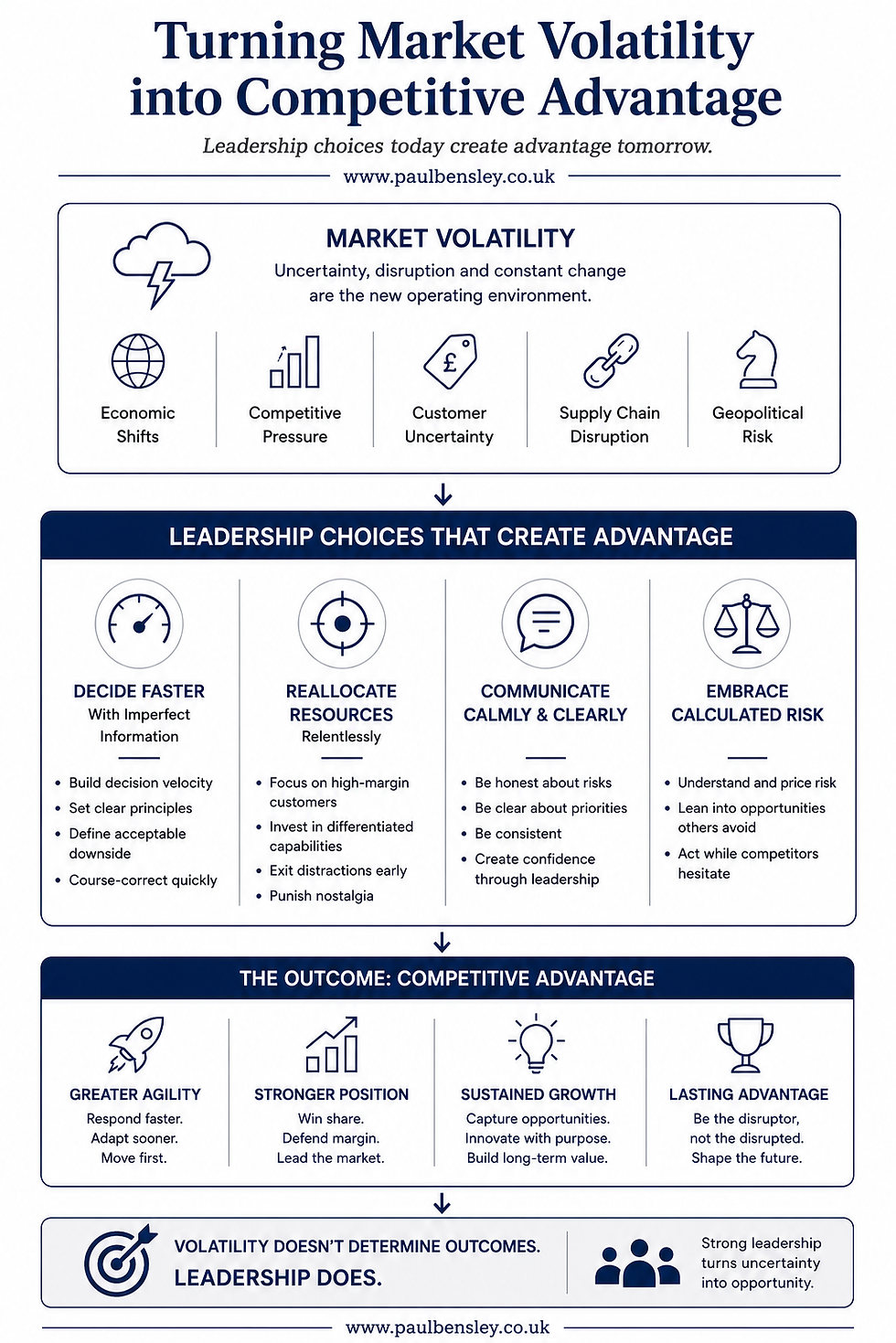
In 2026, volatility isn’t a temporary condition to endure - it’s the operating environment.
The leaders who win won’t just survive disruption. They’ll convert uncertainty into advantage.
Resilience Is Defensive. Advantage Is Strategic.
Resilience asks:
How do we protect ourselves if things go wrong?
Advantage asks:
How do we move faster, smarter, and more decisively than competitors when things change?
The difference is subtle and critical.
Resilient organisations absorb shocks. Advantaged organisations benefit from them.
The Leaders Who Win Think Differently About Risk
High-performing leaders don’t see risk as something to minimise at all costs. They see it as something to understand, price, and deploy deliberately.
They ask:
Which risks are existential and which are optional?
Where is the market hesitating that we can lean into?
What decisions are our competitors delaying that we can make now?
Volatility creates hesitation. Hesitation creates opportunity.
Three Ways Leaders Turn Volatility into Competitive Advantage
1. They Decide Faster - With Imperfect Information
Waiting for perfect data is a luxury volatile markets don’t offer.
The best leaders build decision velocity, not decision certainty. They set clear principles, define acceptable downside, and move knowing they can course-correct faster than slower competitors.
Speed becomes a moat.
2. They Reallocate Resources Relentlessly
Advantaged organisations don’t spread resources evenly “just in case.”
They double down on:
High-margin customers
Differentiated propositions
Capabilities competitors struggle to replicate
And they exit distractions early, even if those distractions once worked.
Volatility punishes nostalgia.
3. They Communicate Calmly and Clearly
Uncertainty amplifies noise internally.
Strong leaders reduce fear by:
Being honest about risks
Clear about priorities
Consistent in messaging
People don’t need certainty, they need confidence that leadership is in control.
The Shift Leaders Must Make
The leadership shift is this:
From defending yesterday’s model To designing tomorrow’s competitive advantage
Volatility isn’t something to wait out. It’s something to use.
And the organisations that recognise this first won’t just be resilient - they’ll be ahead.
If you found this article useful, you may also enjoy:
FAQs
What is market volatility in business?
Market volatility refers to rapid or unpredictable changes in the conditions affecting a business, including customer demand, costs, supply chains, interest rates, regulation, technology and competitor behaviour. For leaders, the challenge is not simply predicting these changes but building an organisation capable of responding effectively when they occur.
How should leaders respond to market volatility?
Leaders should protect the organisation against risks that could cause serious damage while remaining flexible enough to exploit opportunities created by change. This requires clear priorities, faster decision-making, disciplined resource allocation and consistent communication rather than simply becoming more cautious.
Can market volatility create competitive advantage?
Yes. Volatility affects competitors differently because organisations respond differently. When some businesses delay decisions, reduce investment or become internally focused, others can gain customers, acquire talent, strengthen capabilities or invest in areas competitors have abandoned.
What is the difference between resilience and competitive advantage?
Resilience is the ability to withstand disruption. Competitive advantage is the ability to perform better than competitors because of it. Resilience protects the organisation from downside risk, while competitive advantage asks how changing conditions can strengthen its relative position.
Why is resilience alone not enough?
A highly resilient business may survive difficult conditions without improving its competitive position. Leaders also need to consider how disruption changes customer behaviour, competitor capability and market opportunities. Surviving volatility and exploiting volatility are different objectives.
How can businesses turn uncertainty into opportunity?
Look for changes in competitor and customer behaviour. Competitors may delay investment, reduce service or retreat from particular markets, while customers may develop new priorities or problems. These changes can create opportunities for organisations willing and able to respond.
Why does volatility create opportunities?
Volatility disrupts established patterns. Customers reconsider suppliers, competitors change priorities and resources become available in different places. It also creates hesitation. Businesses capable of acting while others are waiting for certainty can sometimes establish positions that become harder to challenge later.
What is decision velocity?
Decision velocity is the ability to make and execute appropriate decisions at the speed circumstances require. It does not mean rushing every decision. It means avoiding unnecessary delays when the cost of waiting is greater than the benefit of obtaining additional information.
Why is decision velocity important during uncertain markets?
The value of information must be balanced against the cost of delay. In volatile markets, waiting for certainty can mean acting after customers, competitors or market conditions have already moved. Leaders therefore need to determine when additional information genuinely improves the decision and when it simply postpones it.
How can leaders make decisions with incomplete information?
Define the objective, understand what is known, identify important assumptions, assess potential downside and determine whether the decision can be reversed. Leaders can then make a proportionate decision and adjust as new information becomes available rather than waiting indefinitely for perfect certainty.
Does faster decision-making mean taking more risk?
Not necessarily. Good decision velocity combines speed with appropriate judgement. Some decisions require extensive analysis because the downside is significant or difficult to reverse. Others can be made quickly, tested and corrected. The skill is knowing which type of decision you are facing.
Can speed become a competitive advantage?
Yes. When two organisations have similar products and capabilities, the one that can recognise change, make decisions and execute effectively faster may capture opportunities before the other responds. Organisational speed can therefore become a competitive capability.
How should leaders think about risk during volatile markets?
Rather than treating all risk as something to minimise, leaders should distinguish between existential risks, manageable risks and risks worth deliberately accepting. The objective is not maximum safety. It is understanding which risks the organisation can afford to take in pursuit of attractive opportunities.
What does it mean to price risk?
Pricing risk means considering the potential downside of an uncertain decision alongside its potential return. Leaders can ask what happens if the assumption is wrong, how much exposure the organisation can tolerate and whether the expected opportunity justifies that exposure.
How should companies allocate resources during uncertainty?
Avoid spreading resources evenly simply to preserve every existing activity. Leaders should identify where the organisation has the strongest opportunity to create value and selectively concentrate people, capital and management attention behind those priorities.
Why is resource reallocation important during market volatility?
Volatility changes the attractiveness of markets, customers and capabilities. Resources allocated according to yesterday's priorities may no longer produce the best return. Businesses that can move resources faster can respond to opportunities while competitors remain constrained by historical commitments.
Should businesses continue investing during uncertain markets?
Selective investment can be strategically valuable. The question should not simply be whether uncertainty makes investment dangerous, but whether competitors' hesitation has made a particular opportunity more attractive. Investment should still have a credible strategic and financial rationale.
When should businesses exit products, customers or markets?
When resources tied to an activity could create greater value elsewhere and there is no credible reason to expect its strategic attractiveness to improve. Volatility can make difficult portfolio decisions more urgent because continuing to support historical priorities can prevent investment in emerging opportunities.
Why can protecting the past become dangerous during volatile markets?
Existing products, customers and capabilities often have strong internal advocates because they produced historical success. But changing markets can alter their value. Volatility punishes nostalgia when organisations continue allocating resources according to what worked previously rather than what will create future advantage.
How should leaders communicate during uncertainty?
Communication should be honest about what is known and unknown, clear about priorities and consistent about the organisation's response. Employees do not require leaders to predict the future perfectly, but they do need to understand what matters and how decisions will be made.
How can leaders maintain employee confidence during uncertainty?
Confidence comes from demonstrating that uncertainty is being actively managed. Leaders should acknowledge risks without amplifying fear, explain priorities clearly and show that decisions are being made deliberately. Confidence in leadership does not require certainty about the environment.
What should CEOs ask during periods of market volatility?
Useful questions include: What has genuinely changed? Which risks could seriously damage us? Where are competitors hesitating? What are customers doing differently? Where should we move resources? Which decisions are we delaying because we want certainty that may never arrive?
How can companies identify opportunities created by competitor hesitation?
Monitor changes in pricing, service levels, investment, recruitment, customer coverage and product development. Speak directly with customers and suppliers about what they are experiencing. Competitor retrenchment often creates signals before it becomes obvious in published performance.
Should businesses wait for market conditions to stabilise before making strategic decisions?
Not necessarily. Some decisions should wait when uncertainty materially affects their economics. But postponing everything until conditions stabilise can itself become a strategic choice, particularly if competitors use the same period to strengthen their position.
What is the biggest leadership mistake during market volatility?
One of the biggest mistakes is allowing uncertainty to become organisational paralysis. Protecting against serious downside is responsible leadership. Using uncertainty as a reason to postpone every difficult decision can allow faster competitors to determine what the market looks like when stability eventually returns.
How do businesses build competitive advantage during uncertain markets?
Protect against existential risks while looking for opportunities created by changing conditions. Make decisions at an appropriate speed, reallocate resources towards the strongest opportunities and maintain enough organisational confidence to execute while others hesitate.
What does it mean to turn volatility into competitive advantage?
It means moving beyond asking:
“How do we survive this?”
and also asking:
“What has changed that could allow us to become stronger relative to our competitors?”
The objective is not simply to emerge from disruption intact, but to emerge in a better competitive position than when it began.


Comments