The Business AI Prompt Framework Cheat Sheet: How to Get Better Results From AI
- Paul Bensley
- Jul 1
- 7 min read
Updated: Aug 27
How to Get Real Value From AI (Without Being Technical)
Think of a prompt as a brief, not a question.
Good briefs create good outcomes. Bad briefs create noise.
This ai prompt framework works across sales, operations, marketing, leadership, and strategy.
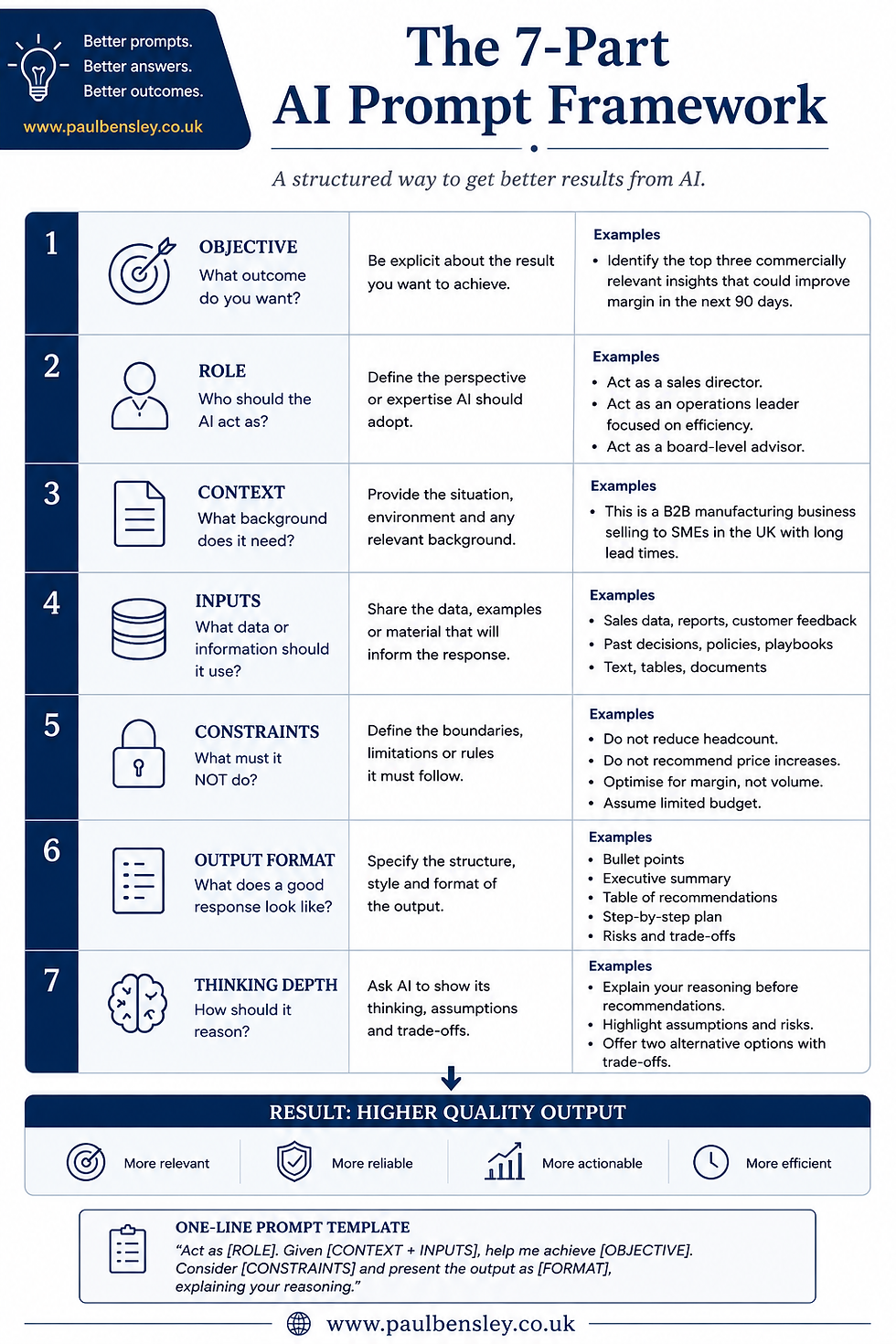
The 7-Part Ai Prompt Framework
You don’t need all seven every time - but the more complex the task, the more you should use.
1. OBJECTIVE
What outcome do you want?
Be explicit.
Don't say: “Analyse this.”
Do Say: “Identify the top three commercially relevant insights that could improve margin in the next 90 days.”
If you can’t state the objective clearly, AI won’t guess it correctly.
3. ROLE
Who should the AI act as?
This sets the lens.
Examples:
“Act as a sales director.”
“Act as a customer with budget constraints.”
“Act as an operations leader focused on efficiency.”
“Act as a board-level advisor.”
Role creates perspective. Perspective creates relevance.
3. CONTEXT
What background does it need?
Assume AI knows nothing about your business.
Include:
Industry
Market conditions
Customer type
Internal constraints
Example:
“This is a B2B manufacturing business selling to SMEs in the UK with long lead times.”
4. INPUTS
What data, examples, or material should it use?
Be specific:
Text
Data tables
Past decisions
Customer feedback
Policies or playbooks
If the input matters - include it.
AI cannot infer what it cannot see.
5. CONSTRAINTS
What must it NOT do?
This is where quality jumps.
Examples:
“Do not reduce headcount.”
“Do not recommend price increases.”
“Optimise for margin, not volume.”
“Assume limited budget.”
Constraints turn generic advice into usable insight.
6. OUTPUT FORMAT
What does “good” look like?
Tell it how to respond:
Bullet points
Table
Executive summary
Step-by-step plan
Risks and trade-offs
Example:
“Respond with a one-page executive summary followed by a table of recommendations.”
7. THINKING DEPTH
How should it reason?
Ask for thinking, not just answers.
Examples:
“Explain your reasoning before giving recommendations.”
“Highlight assumptions and risks.”
“Offer two alternative options with trade-offs.”
Trust comes from transparency, not confidence.
The One-Line Prompt Template
Use this when you want something fast but structured:
“Act as [ROLE]. Given [CONTEXT + INPUTS], help me achieve [OBJECTIVE]. Consider [CONSTRAINTS] and present the output as [FORMAT], explaining your reasoning.”
A Real Example (Sales)
“Act as a sales director. Given the attached customer sales data for the last 12 months, identify patterns that explain margin variance across regions. Optimise for margin (not volume), do not recommend price increases, and present findings in a short executive summary with actionable recommendations.”
A Real Example (Operations)
“Act as an operations leader. Using the attached service history and failure data, identify the top three preventative maintenance opportunities. Assume limited budget, no headcount increase, and present recommendations with risk trade-offs.”
Common Prompt Mistakes (Avoid These)
Asking vague questions
Skipping context
Forgetting constraints
Expecting perfection in one attempt
Treating AI like Google
AI rewards iteration, not perfection.
Final Rule to Remember
If the prompt feels unclear, the output will be too.
AI doesn’t replace thinking. It multiplies it.
And prompts are where that multiplication happens.
Read the article that informed this checklist: Most People Don’t Know How to Talk to AI.
If you found this article useful, you may also enjoy:
FAQs:
What is an AI prompt?
An AI prompt is the instruction, question or information given to an AI system to guide its response. A good business prompt provides enough context, purpose and direction for the AI to understand not only what you are asking it to do, but what a useful answer should look like.
How do you write a good AI prompt for business?
Start by explaining what you are trying to achieve, the relevant business context, what you want the AI to do and any important constraints or expectations for the output. The quality of an AI response often depends on the quality and relevance of the information provided to it.
What is the Business AI Prompt Framework?
The Business AI Prompt Framework, developed by Paul Bensley, is a practical structure designed to help businesspeople give AI the context and direction it needs to produce more useful outputs. Rather than relying on clever prompt wording, it encourages users to structure requests around the business problem, relevant context and required outcome.
Why do AI prompts need business context?
AI may understand the task but not automatically understand your organisation, customers, objectives, constraints or commercial situation. Providing relevant context reduces the amount the AI has to assume and makes it more likely that the response will be useful for the specific business problem.
Why do I get generic answers from AI?
Generic answers are often the result of generic inputs. If you ask a broad question without explaining the situation, AI has little choice but to provide a broadly applicable response. Adding specific context, objectives, constraints and relevant information gives the AI a better basis for producing a tailored answer.
Do you need to be good at prompt engineering to use AI for business?
No. Most business users do not need to become specialist prompt engineers. The more important skill is being able to define the problem clearly, provide relevant context and recognise what a good answer should contain. Strong business thinking often matters more than sophisticated prompt terminology.
Should you give AI a role in a prompt?
Giving AI a role can sometimes help establish perspective, but simply writing “act as an expert” does not guarantee a better answer. Providing relevant business context, evidence and a clear objective is usually more valuable than relying on an impressive-sounding persona.
How much context should you give AI?
Provide enough context to explain the factors that materially affect the answer, but avoid adding irrelevant information simply to make the prompt longer. Useful context might include the business objective, customer, audience, constraints, available data, previous decisions and the outcome you need.
Should you ask AI one big question or several smaller questions?
For complex business problems, an iterative conversation is often more effective than attempting to create one enormous perfect prompt. Start with the problem, examine the initial response, add missing information, challenge assumptions and refine the answer. Using AI well is often a conversation rather than a single command.
Can AI ask me questions before giving an answer?
Yes, and this can significantly improve results when important context is missing. You can instruct AI to ask relevant questions before making a recommendation. This is particularly useful for strategic, commercial or organisational problems where the quality of the answer depends heavily on understanding the situation.
How can I get AI to challenge my thinking instead of agreeing with me?
Explicitly ask it to identify weak assumptions, contradictory evidence, alternative explanations and reasons your preferred approach might fail. AI can be particularly useful as a thinking partner when it is asked to challenge a decision rather than simply justify one.
How can I get more accurate answers from AI?
Provide relevant source information where possible, distinguish facts from assumptions and ask the AI to identify uncertainty rather than guess. Important information should still be verified, particularly where decisions involve financial, legal, safety or other significant consequences.
What information should businesses avoid putting into AI prompts?
Employees should follow their organisation's AI and data-security policies and avoid entering confidential, personal, commercially sensitive or restricted information into tools that have not been approved for that purpose. Businesses should establish clear guidance rather than leaving individual employees to determine acceptable use themselves.
Can better prompts improve AI productivity?
Yes. Clearer prompts can reduce the number of iterations required and produce outputs that are closer to what the user actually needs. However, productivity should not be measured simply by how quickly AI produces something. The output still needs to be useful, accurate and capable of improving the underlying work.
What are the most common AI prompting mistakes?
Common mistakes include providing too little context, asking vague questions, failing to define the desired outcome, accepting the first response without challenge and assuming the AI understands information that was never provided. Better prompting is often less about clever wording and more about clearer thinking.
Can AI prompts be reused across a business?
Yes. Effective prompts can be turned into templates or repeatable workflows for common activities such as analysis, customer research, meeting preparation, sales support or communication. However, templates should leave room for the context that changes from one situation to another.
How should managers teach employees to use AI prompts?
Start with real work rather than abstract prompt-engineering theory. Take a task employees already understand and demonstrate how adding context, objectives, constraints and examples changes the quality of the AI output. Employees can then learn through practical experimentation with their own work.
Is prompting AI a technical skill or a business skill?
For most employees, effective prompting is increasingly a business skill supported by technology. The user needs to understand the problem, recognise relevant context, communicate clearly and evaluate the response. AI cannot compensate for someone who does not understand what a good business outcome looks like.
Can AI make good decisions if I give it a good prompt?
A strong prompt can improve the quality of AI analysis, but it does not remove the need for human judgement. AI may still lack important context, make incorrect assumptions or generate plausible but inaccurate information. Leaders remain responsible for determining whether an AI-supported recommendation makes sense.
What is the best way to get better results from AI?
Focus less on finding a “perfect prompt” and more on improving the quality of the conversation. Give AI relevant context, define the objective, ask it to challenge assumptions, provide additional information when needed and critically evaluate the response. Better AI outputs usually begin with better human thinking.

Comments